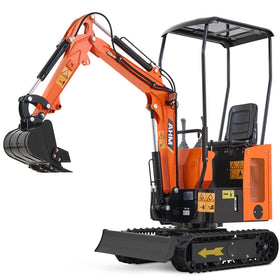
If you’ve ever tried to break up concrete, rock, or compacted ground with just a mini excavator bucket, you already know how much of a difference having a hydraulic hammer makes.
A hydraulic hammer attachment turns your mini excavator from a digging machine into a serious demolition tool and gives you the breaking power you need when working on concrete slabs or footings, asphalt removal, rock breaking, or tough, compacted soil.
But here’s the catch: not all hydraulic hammers are created equal, and picking the wrong one can not only impede your performance but can also cause excessive wear on your machine or even costly damage. That’s why understanding how to match the hammer to your mini excavator is critical.

How to Pick the Best Hydraulic Hammer for Your Mini Excavator
The goal, when choosing a hydraulic hammer for a mini excavator, is to get a hammer that best matches your excavator’s size and hydraulic system, delivers efficient breaking power, and doesn’t overload or damage your machine
In simple terms, you are looking for maximum performance without stressing your excavator. Before looking at the type of tool and its breaking power, you have to assess how well it matches the weight class of your machine and hydraulic flow/pressure. Carefully consider the following factors:
1. Make Sure it Matches The Weight Class of Your Excavator
The weight class of your excavator is the first step to consider when choosing a hydraulic hammer breaker. Mini excavators typically range from 1 to 10 tons, and every hammer is designed for a specific weight range.
Starting with your mini excavator weight class prevents you from making the mistake of buying a hydraulic hammer that is too heavy or too light. Too heavy, and the hammer is unstable and damaging to use. Too light and it becomes weak and inefficient.
2. Check its Hydraulic Flow and Pressure
Every hydraulic hammer has specific specs for flow rate (GPM) and operating pressure (PSI). These are the two specifications that ensure your hammer hits properly and the internal components don't get damaged as you use it. Always match the hammer to your machine’s hydraulic output.

3. Check Its Impact Energy (Breaking Power)
The impact energy determines how hard the hammer hits. When it comes to hydraulic hammers, more power is not always better. The goal here is to find the hydraulic breaker with the right amount of impact energy for the kind of mini excavator jobs that you usually do.
If you mostly work on soil or small concrete, go for a light-duty hydraulic breaker
For standard demolition, choose a medium-duty hydraulic hammer
For breaking rocks and thick concrete, go for a heavy-duty hydraulic hammer.
4. Consider the Tool Types It Is Compatible With
A mini excavator hydraulic hammer comes with different bits for different jobs. The most commonly used are: the chisel, moil, and blunt tool.
- The chisel is for breaking concrete and slabs
- The moil (point) is for rock and precision breaking
- The blunt tool is best for general demolition
Having and using the right tool for the right job not only increases the efficiency of your breaking, but also reduces wear on the hammer attachment.
5. Ensure Mounting Compatibility
Knowing how to install a hydraulic hammer on a mini excavator is very important. If it doesn't mount correctly, it doesn't matter how good the hammer is. Ensure that the pin size and spacing are proper, and consider pin-on vs quick coupler compatibility.
6. Build Quality and Maintenance
Hydraulic hammers take a beating, and low-quality ones never last. Ensure that it has durable housing, and it can be serviced easily in your area. In case of a breakdown, you also want to make sure that you can get replacement parts easily.
 What the Ideal Hydraulic Hammer Looks Like
In summary, the ideal hammer for your mini excavator will match your machine’s weight and hydraulic specs perfectly, deliver consistent, controlled impact power, mount easily and securely, and be durable enough for repeated heavy use. When everything lines up, the hammer feels like a natural extension of your machine, not a strain on it.
AHM Hydraulic Breaker Hammer: Perfect for Landscaping, Construction, Light Demolition, and More
Turn your mini excavator into a powerful demolition machine with this hydraulic breaker hammer for mini excavator by AHM. With an impressive impact rate ranging from 500 to 1200, it is compatible with mini excavators up to 2 tons.
The small digger attachment seamlessly integrates with your equipment, and its two 1.4-inch chisels are perfect for drilling and breaking tasks, from landscaping to construction and light demolition.
Benefits of Choosing the Right Hydraulic Hammer
Compatibility is key when choosing a hydraulic hammer for a mini excavator; it is the foundation for quick, efficient, and long-term usage. Again, a properly matched hydraulic hammer runs efficiently, hits with full power, and minimizes wear on your excavator. Once you have the right setup, your mini excavator becomes far more capable:
- Breaks concrete and rock quickly
- Expands the types of jobs you can take on
- Reduces manual labor and time
- Increases job site efficiency
- Boosts overall profitability
If the hydraulic hammer is mismatched, you get nothing but a weak performance, the hydraulics overheat pretty quickly (and often), and you spend tons of money on repairs.
Mini Excavator: With vs Without a Hydraulic Hammer
| Feature | Without Hydraulic Hammer | With Hydraulic Hammer |
| Job Capability | Limited to digging and lifting | Can handle demolition and breaking |
| Efficiency | Slower on tough materials | Fast and effective breaking |
| Labor Required | More manual work | Less physical labor |
| Versatility | Basic tasks only | Multi-purpose machine |
| Job Opportunities | Limited scope | Wider range of projects |
| Profit Potential | Lower | Higher with expanded services |
Best Uses for a Mini Excavator Hydraulic Hammer
After choosing the best mini excavator hydraulic hammer, you need to know what exactly to do with it: the optimal uses for it. Because a hydraulic hammer converts hydraulic energy into repeated impact force, it is best used when you need to break through hard materials instead of just moving them.
Concrete demolition is one of the main uses of a hydraulic hammer, but it is also commonly used when working with asphalt, rocks, and projects on hard ground.

Main Uses of a Mini Excavator Hydraulic Hammer
- Concrete demolition: Demolishing and breaking sidewalks, driveways, and foundations. The main application of a hydraulic hammer tool.
- Asphalt removal: Road repairs, parking lots, trenching through paved surfaces, etc
- Rock Breaking: breaking boulders, trenching in rocky soil, and site preparation.
- Trenching in hard ground: When soil is too compacted for a bucket, a hammer makes the job possible.
- Fence post and pole removal: It breaks up concrete footings quickly and cleanly.
Light demolition work: small structures, retaining walls, and old installations.
Final Thoughts on Choosing a Mini Excavator Hydraulic Hammer
A hydraulic hammer is one of the most impactful upgrades you can add to a mini excavator. It takes your machine from “capable” to seriously versatile.
The key to choosing the best one is to match the specs, understand the demands of your workload, and invest in quality. Do that, and you’ll not only make your jobs easier, but you’ll also open the door to work you couldn’t take on before. You may also be interested in mini excavator hydraulic augers and other mini excavator attachments to consider for your machine.