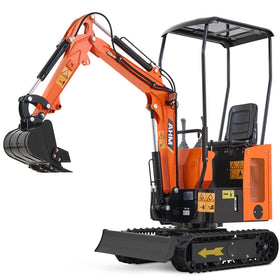
Choosing the right grading bucket for a mini excavator is much more than picking one that fits your machine. The real goal should be to match the bucket to your machine’s weight class and kind of work you actually do so you can grade smoothly, maintain control, and avoid unnecessary strain on your equipment.
A good grading bucket should help you create clean, level surfaces with minimal passes while still being durable enough for regular use in soil, gravel, and light material handling.

3 Key Selection Criteria for a Mini Excavator Grading Bucket
Several important factors determine whether a grading bucket is the right match for your machine and your work.
1. Check the Bucket Width
A mini excavator bucket's width is one of the most important choices you’ll make. A wider bucket allows you to cover more ground in fewer passes, which is ideal for grading driveways, landscaping, and site preparation. However, going too wide can reduce control and put extra stress on the machine, especially on smaller mini-excavators.
Mini Excavator Grading Bucket Size Chart
| Mini Excavator Weight | Recommended Grading Bucket Width | |
| 1.0 to 1.9 Tons | 36" to 39" (900mm–1000mm) | |
| 2.0 to 3.5 Tons | 48" (1200mm) | |
| 4.0 to 5.0 Tons | 50" to 60" (1500mm) | |
| 6.0 to 8.0 Tons | 60" to 72" (1800mm) |
- A width that matches your machine’s lifting and breakout capacity
- A balance between coverage and maneuverability
- Compatibility with typical jobsite access areas
2. Consider the Bucket Capacity
The capacity of a grading bucket is simply the amount of material the bucket can hold in a single scoop. Mini excavator grading and ditching bucket capacities generally range from 1.5 to 10 cubic feet (0.05 to 0.35 cubic yards), depending on your machine's weight class. Generally smooth, wide buckets (or "butter bars") are best for finish grading, preferably with a hydraulic tilt feature for maximum efficiency.
Grading Bucket Capacities by Machine
| Mini Excavator Size | Bucket Capacity | |
| 1 to 2-Ton Class (e.g., Kubota U17, Bobcat E17) | 1.5 to 2.5 cubic feet. | 36 to 39 inches |
| 3 to 4-Ton Class (e.g., Kubota U35, Bobcat E35): |
2.5 to 4.5 cubic feet |
42 to 48 inches |
| 5 to 6-Ton Class (e.g., Kubota KX057, Bobcat E55) | 5.0 to 8.0 cubic feet |
48 to 60 inches |
- Micro-excavators (under 2 tons) struggle to lift wide buckets filled with dense, wet clay. Keep your total bucket + dirt weight under 10% of the machine's overall weight.
- Also, larger capacity increases productivity, but it also adds weight, which can slow down your machine and reduce precision when grading.
- Look for capacity suited to your excavator’s size class, good balance between efficiency and control, and avoid oversized buckets that overload the machine.
3. Standard vs. Hydraulic Tilt Bucket
Mini excavator grading buckets generally come in two main designs: standard and hydraulic tilt buckets. The design affects how versatile the bucket is and how cleanly it cuts and spreads material.
- Standard rigid grading buckets are flat, straight edges with zero teeth. They are more budget-friendly and highly durable. However, you must align the entire machine tracks perfectly to get a flat grade.
- Hydraulic tilting buckets articulate 45 degrees left and right, which allows you more versatility and precision when cutting drainage slopes, ditches, and crowns without constantly repositioning the tracks. They are highly favored by heavy equipment operators.
Mini Excavator Grading Bucket Size Recommendation Chart
| Mini Excavator Weight | Recommended Grading Bucket Width | Recommended Grading Bucket Capacity |
| 1.0 to 1.9 Tons | 36" to 39" (900mm–1000mm) | 36 to 39 inches |
| 2.0 to 3.5 Tons | 48" (1200mm) | 42 to 48 inches |
| 4.0 to 5.0 Tons | 50" to 60" (1500mm) | 48 to 60 inches |
| 6.0 to 8.0 Tons | 60" to 72" (1800mm) | 60+inches |
 Choosing a Mini Excavator Grading Bucket: Essential Design Features To Consider
-
Choose one with a bolt-on cutting edge (BOCE): For a mini excavator, always look for a grading bucket with dual-sided, reversible bolt-on cutting edges. That way, when one side wears down, you simply flip it over to prolong the main bucket structure's lifespan. These tend to last much longer than those with a fixed, welded-on front edge.
-
Make sure it matches your track width: Choose a grading bucket that is at least as wide as the outer edge of your mini excavator tracks. This is essential for balance and smooth operation, especially when you are moving bulk material.
-
Check for straps at the back: Check the rear profile of the bucket. The best quality aftermarket ones usually come with thick wear plates or straps on the back bottom corner. These are very helpful because if you are like most operators, you will probably be using back-dragging (or back-blading)to achieve a smooth finish.
-
Match the ear and pin dimensions: Mini excavator attachments are not universally interchangeable. You must exactly match your machine's hitch pin diameter, dipper ear width, and pin center-to-center distance.
Best Mini Excavator Trenching Buckets From AHM
1. AHM 500mm Mini Excavator Plain Flat Bucket Attachment
The AHM 19.7 in. (500 mm) mini excavator bucket has a 1.06 cu. ft. capacity, and is perfect for all loading and earthmoving operations.
Its toothless design makes it ideal for ditch cleaning and land levelingThe flat tooth bucket features a 3.66 in. (93 mm) span, a 0.98 in. (25 mm) arm pin housing distance, and a 3.54 in. (90 mm) center wheelbase. It is designed to fit AHM mini excavators and various others up to 2 tons.
With 2 hinge pins and 2 nuts included, our mini excavator plain bucket ensures a quick and hassle-free setup.
2. AHM 12" Narrow Bucket Attachment Trenching Bucket for Mini Excavator Digger
Enhance your mini excavator with the AHM 12-inch Narrow Bucket Attachment, a must-have tool for effective digging and trenching in tight spaces. The AHM 12" (300 mm) narrow bucket is perfect for digging trenches in soil, sand, clay, and other light to medium materials.
It's ideal for pipeline excavation, trench filling, and river dredgingThis narrow bucket features a 3.62 in. (92 mm) span, a 0.98 in. (25 mm) arm pin housing distance, and a 3.54 in. (90 mm) center wheelbase. It is designed to fit AHM mini excavators and various others up to 2 tons.
Choosing a Mini Excavator Grading Bucket: Why the Coupler Matters
Not all buckets fit all machines, even within the same weight class. Mounting style, pin size, and linkage geometry all need to match.
Choosing a grading bucket based on the exact machine model and its specific coupler system prevents sizing mismatches. Because mini excavator attachments are not universally interchangeable across brands, you must cross-reference your exact model, the coupler mechanics, and the factory pin size to ensure a perfect fit.
Ensure the pin size and spacing are correct, the bucket is compatible with the coupler (if you are using one), and the weight rating is suited to your excavator model.

Mini Excavator Grading Bucket Selection Chart (Popular Models/Coupler Types)
| Make and Model | Weight Class | Factory / Popular Coupler Type | Pin Diameter | Recommended Grading Bucket Width |
| Kubota KX033-4 / U35 | 3.5 Tons | Kubota Quick Attach (OEM style / Rhinox K7870A) | 40 mm | 48" (1200mm) |
| Kubota KX040-4 | 4.0 Tons | Kubota Quick Attach (Dedicated Hook) | 40 mm | 48" to 50" |
| John Deere 26G | 2.6 Tons | John Deere Wedge Lock / Manual Quick Coupler | 35 mm | 39" to 42" |
| John Deere 35G | 3.5 Tons | Spring-Loaded Manual or Hydraulic Wedge Lock | 40 mm | 48" |
| Caterpillar 303 / 303.5 | 3.5 Tons | Cat Dual Lock or CW-05 Hydraulic Spindle | 40 mm | 48" (1200mm) |
| Caterpillar 305 / 306 CR | 5.0–6.0 Tons | Cat Pin Grabber / CW-10 Series | 45 mm | 50" to 60" |
| Bobcat E26 / E35 | 2.6–3.5 Tons | Bobcat X-Change System (Wedge/Pinless) | N/A (Dedicated Hook) | 48" |
| Takeuchi TB230 / TB235-2 | 3.0–3.5 Tons | Pin Grabber or Multi-Hitch Manual Quick Coupler | 35 mm / 40 mm | 48" |
-
Dedicated Brand Systems (Kubota QA & Bobcat X-Change): These systems utilize a unique hook-and-pin setup instead of standard pin configurations. If you have these couplers, you cannot buy standard "pin-on" aftermarket buckets unless they explicitly state they have Kubota ears or a Bobcat frame.
-
Wedge-Lock Couplers (Deere / Hitachi): Popularized by John Deere, these couplers drop down and slide a physical wedge over the back pin. They require specific bucket hangers shaped to receive the locking wedge tightly.
-
Pin Grabber Couplers (Cat / Universal): These are highly versatile because they can catch different buckets with variable center-to-center pin spacings, provided the pin diameter matches your machine. They add extra weight to the end of the stick, which means you should lean toward the narrower end of the grading bucket spectrum to protect your tipping capacity.
Key Tips for Choosing a Mini Excavator Grading Bucket
-
Match the bucket to your most common job: Think about what you do most often. If you primarily work on landscaping or finishing driveways, prioritize precision and smooth grading ability over raw capacity.
-
Don’t oversize the bucket: It’s tempting to go bigger for productivity, but oversizing can slow down cycle time, reduce grading accuracy, and put strain on your machines' hydraulic systems. A properly sized bucket will actually make you faster in the long run.
-
Consider a tilt or high-performance option: If your work involves slopes, uneven terrain, or detailed grading, a tilt bucket or specialized grading bucket can significantly improve results. These options allow better control over angles and surface finish.
-
Look at long-term wear resistance: A cheaper bucket may save money upfront but wear out quickly in abrasive conditions. Reinforced edges and durable steel construction usually pay off over time.
-
Think about visibility and control: A good grading bucket should allow you to see the cutting edge clearly from the cab. Better visibility leads to more precise grading and fewer mistakes.
-
Make sure it matches your attachments: If you use a quick coupler system, double-check full compatibility before buying. Even small mismatches can cause performance issues or safety concerns.

Final Thoughts on Choosing The Right Grading Bucket for a Mini Excavator
The right grading bucket for your mini excavator is the one that fits your machine properly, matches your workload, and gives you the control needed for smooth, accurate grading. When you focus on the balance between width, capacity, durability, and compatibility, you end up with a bucket that doesn’t just work; it makes your entire job easier and more efficient.
A well-chosen grading bucket turns a mini excavator into a precise finishing tool, not just a digging machine.
You may also be interested in how to grade a yard with a mini excavator.