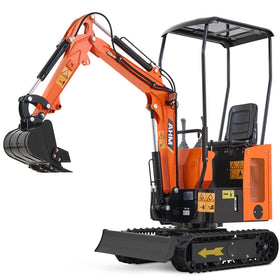
One of the biggest mistakes new mini excavator owners make is assuming that any bucket that fits their machine will perform equally well. But it is not just about the fit: the size of the bucket size has a major impact on the mini excavator’s digging speed, breakout force, fuel efficiency, trench accuracy, and overall productivity.
This is why understanding mini excavator bucket sizes is essential whether you are purchasing your first bucket, adding attachments to your fleet, or simply trying to improve productivity on the jobsite.
A bucket that is too small may force you to make unnecessary passes, slowing down the job. A bucket that is too large can overload the machine, reduce digging performance, and place additional stress on the excavator's hydraulic system and linkage components.
 General Mini Excavator Bucket Size Categories
Most mini excavator buckets can be grouped into three broad size categories: small buckets, medium buckets, and large buckets.
1. Small Buckets (6–12 Inches)
These are narrow buckets designed primarily for precision work. They excel at utility trenches, irrigation lines, electrical conduit installation, fiber optic work, and drainage projects. The main advantage is accuracy and reduced backfill requirements.
2. Medium Buckets (12–24 Inches)
These are the most versatile bucket sizes. They are commonly used for general excavation, landscaping, foundation work, small construction projects, and material handling. Many contractors consider a medium bucket their everyday workhorse.
3. Large Buckets (24–48+ Inches)
Large buckets prioritize volume over penetration. They are ideal for bulk excavation and topsoil movement, site preparation, grading, and finishing work. However, larger buckets require larger machines to maintain productivity.
Mini Excavator Bucket Dimensions by Machine Weight
One of the easiest ways to select a bucket is to start with machine weight. Manufacturers design excavators with specific breakout forces and hydraulic capabilities. Matching bucket size to machine size helps ensure optimal performance.
1-2 Ton Mini Excavators Bucket Sizes
The typical bucket sizes for 1-2 ton mini excavators are 6", 9", 12", 18", and 24" buckets. They are best for small trenches, backyard projects, utility repairs, and tight-access excavation. Most owners find that an 18-inch bucket serves as a good general-purpose option.
2–4 Ton Mini Excavator Bucket Sizes
Typical bucket sizes for 2-4 ton mini excavators are 9", 12", 18", 24", 30" buckets. These machines have enough power to handle larger buckets while remaining maneuverable. An 18-inch or 24-inch bucket is often the primary digging bucket for this size range.
4–6 Ton Mini Excavator Bucket Sizes
These machines bridge the gap between compact equipment and full-size excavation equipment. Typical bucket sizes include: 12", 18", 24", 30", 36" buckets. They are commonly used for commercial landscaping, foundation excavation, utility installation, and site development. A 24-inch bucket is often considered the standard general-purpose size.
6–10 Ton Mini Excavator Bucket Sizes
Larger mini excavators can effectively handle wider buckets and larger material volumes. Typical bucket sizes are 18", 24", 30", 36", 48" buckets. These machines can efficiently move significant amounts of material while maintaining good digging performance.
Mini Excavator Bucket Dimensions Chart (By Mini Excavator Weight)
| Excavator Size Class | Typical Machine Weight | Common Digging/Trenching Bucket Widths | Common Grading/Clean-Up Bucket Widths |
| Micro/Mini Excavators | Under 2 tons | 6–12 in. (trenching), 16–24 in. (general digging) | 30–39 in. (smooth grading buckets) |
| Mid-Size Mini Excavators | 2–3.5 tons | 9–24 in. (standard digging buckets) | Up to 48 in. (clean-up and grading buckets) |
| Large Mini Excavators | 4–8 tons | 18–30 in. (general excavation buckets) | 36–60 in. (heavy grading or tilting ditching buckets) |
Choosing Bucket Sizes by Application
1. For Trenching
Trenching with a mini excavator usually requires the narrowest practical bucket. Typical trenching bucket sizes include: 6 inches, 9 inches, and 12 inches. Narrow buckets provide less excavation volume and are great for faster trench completion. For utilities, narrower is usually better.
The AHM 12" (300 mm) narrow bucket is perfect for digging trenches in soil, sand, clay, and other light to medium materials. It's ideal for pipeline excavation, trench filling, and river dredging
Ideal for Mini Excavators: This narrow bucket features a 3.62 in. (92 mm) span, a 0.98 in. (25 mm) arm pin housing distance, and a 3.54 in. (90 mm) center wheelbase. It is designed to fit AHM mini excavators and various others up to 2 tons
2. For General Digging
General digging/excavation demands a balance between penetration and productivity. Typical bucket sizes include: 18 inches, 24 inches, and 30 inches. These sizes offer good versatility for landscaping, foundation preparation, general earthmoving, and general residential construction. Most contractors spend the majority of their time using buckets in this range.
3. For Grading
Grading focuses on creating smooth, level surfaces rather than digging deeply. Typical grading bucket sizes include 36 inches, 42 inches, 48 inches, and wider ditch-cleaning buckets. The wider profile helps smooth material efficiently while covering more ground. Exploring more on how to grade land with a mini excavator.
4. For Ditch Cleaning
Ditch-cleaning buckets are designed with wide, shallow profiles. They are commonly used for drainage ditches, pond maintenance, roadside drainage, and swales. Their shape allows operators to shape and clean surfaces rather than aggressively excavate.
5. For Rock and Demolition Work
Rock buckets often use narrower widths to maximize digging force. Common sizes include 12 inches, 18 inches, and 24 inches. The narrower profile concentrates the machine's force into a smaller area, improving penetration in difficult conditions.
Mini Excavator Bucket Sizes Chart (By Application)
| Bucket Type | Typical Width | Best Uses | Notes |
| Trenching Bucket | 6–12 in. | Installing utility lines, water pipes, drainage systems, and footings | Narrow profile minimizes excavation volume. 12-inch buckets can have difficulty dumping sticky clay or wet, rocky soil cleanly. |
| General Digging Bucket | 16–24 in. | Moving bulk material, digging foundations, clearing stumps, and general excavation | Considered the "sweet spot" for mini excavators because it balances breakout force, digging efficiency, and bucket capacity. |
| Grading and Ditching Bucket | 30–48+ in. | Finish grading, backfilling trenches, shaping slopes, clearing ditches, and site cleanup | Typically smooth-edged and toothless. Hydraulic tilting grading buckets are popular for frequent leveling and precision grading work. |
How Mini Excavator Buckets Are Measured
When people talk about bucket sizes, they often focus solely on bucket width. But while the width of the bucket is absolutely important, it is only one part of the equation. Mini excavator buckets are typically classified using several criteria:
- Bucket width
- Bucket capacity
- Bucket type
- Material density
- Machine compatibility
- Intended application
Understanding these classifications makes it much easier to select the correct bucket.
1. Bucket Width
Bucket width is the most commonly referenced measurement. Mini excavator buckets are often available in widths ranging from as little as 6 inches to more than 48 inches.
- Narrow buckets create less soil disturbance.
- Wider buckets move more material per pass.
- Extremely wide buckets are primarily used for grading and finishing work.
The width you choose directly affects both productivity and precision.
2. Bucket Capacity
Two buckets may have the same width but different capacities. Capacity refers to how much material the bucket can hold. Factors affecting capacity include bucket depth, side profile, overall shape, and material design. A deeper bucket may carry significantly more material than a shallower bucket of the same width.
3. Bucket Type
Different bucket styles are designed for different tasks. The most common mini excavator bucket categories are trenching buckets, digging buckets, heavy-duty buckets, grading buckets, ditch cleaning buckets, and rock buckets. Each type balances penetration, capacity, durability, and finish quality differently.
 Key Tips for Choosing the Right Mini Excavator Bucket Size
1. Soil Conditions Matter
If you operate in dense clay, shale, or rocky soil, downsize your bucket width. A bucket that is too wide won't be able to cut through the ground, pulling your tracks forward instead.
2. Verify Pin Dimensions
When buying aftermarket buckets, matching the machine width isn't enough. You must measure your pin diameter (e.g., 25 mm, 30 mm), ear spacing, and pin center-to-center distance to guarantee compatibility
3. Choose the Job First, Then the Bucket
Many buyers start with machine specifications. A better approach is to start with the work you perform most often. Ask yourself:
- Do I primarily trench?
- Do I move bulk material?
- Do I grade and finish?
- Do I excavate foundations?
The answer usually points toward the correct bucket size.
4. Don't Buy Just One Bucket
Many experienced operators own multiple buckets. A typical setup may include: one trenching bucket, one general-purpose bucket, and one grading bucket. Switching buckets often improves productivity more than upgrading machines.
5. Consider Soil Conditions
Bucket selection changes dramatically depending on the material. Loose topsoil allows larger buckets. Heavy clay, rocky ground, and compacted soil often favor narrower buckets. The harder the digging conditions, the more important the breakout force becomes.
6. Think About Transportation and Access
Large buckets may not fit through gates, fences, or confined work areas. If most of your work occurs in residential backyards, oversized buckets can become impractical regardless of machine size.
7. Consider Quick Coupler Compatibility
If you regularly switch attachments, make sure the bucket is compatible with your quick coupler system. The convenience of fast bucket changes often encourages operators to use the correct bucket for each task instead of trying to force one bucket to do everything.
 Final Thoughts on Mini Excavator Bucket Sizes
For trenching, narrow buckets typically provide the best results. For general excavation, medium-sized buckets offer the greatest versatility. For grading and finishing, wider buckets can dramatically improve productivity and surface quality.
Ultimately, the best bucket is not necessarily the biggest one. It is the bucket that matches your machine, your material conditions, and the work you perform most often. By carefully considering these factors, you can maximize productivity, reduce wear on your equipment, and get more value from your mini excavator.
You may also be interested in mini excavator bucket teeth types and how to choose between them.