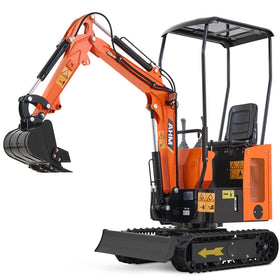
It's All About the Swing Boom!
Imagine you're digging a trench along your house foundation for a French drain. With a fixed boom excavator, you park at a 45-degree angle to the wall, rotate the cab, and hope you can reach without hitting the siding. Every 10 feet, you stop, reposition the entire machine, and start over. The job that should take 2 hours stretches into 4 because you spend half your time repositioning.
A swing boom mini excavator changes this completely. The boom pivots 45-55 degrees side-to-side independently from the cab, letting you dig parallel to walls, fences, and structures without moving the tracks.
What makes understanding swing boom vs fixed boom mini excavator important? The boom type determines how much time you waste repositioning versus actually digging - and on confined residential sites where you can't easily maneuver, that can be the difference between projects staying profitable or becoming frustrating.

Why Boom Type Matters for Mini Excavator Work
Boom configuration directly impacts your excavator's versatility and efficiency in tight spaces. The difference between swing and fixed booms shows up most clearly when working alongside obstacles - the exact conditions homeowners and residential contractors face constantly.
Fixed boom excavators lock your digging position relative to the tracks. Want to dig along a fence line? You must position the entire machine parallel to that fence. In backyards with gardens, trees, and existing landscaping, finding that space becomes the bottleneck.
Swing booms break this limitation. Park perpendicular to the obstacle and swing the boom to work alongside it. Industry studies show swing booms reduce repositioning time by approximately 50%, directly translating to faster completions and lower labor costs.
What is a Fixed Boom Mini Excavator?
A fixed boom mini excavator has a boom rigidly attached to the excavator's rotating cab. The boom only moves up and down through its vertical range - there's no side-to-side pivot capability at the boom's base.
Fixed booms offer simplicity - fewer moving parts, less maintenance, and potentially higher lifting capacity since there's no pivot joint reducing structural strength. The straightforward design also typically costs less upfront.
What is a Swing Boom Mini Excavator?
A swing boom pivots left and right independently from the excavator's cab rotation. Hydraulic cylinders power the pivot point at the boom's base, typically providing 45-55 degrees of movement in each direction. Operators report completing foundation work in 10 minutes with swing booms versus hours with fixed booms.

Swing Boom vs Fixed Boom: Key Differences
| Feature | Fixed Boom | Swing Boom |
| Movement Range | Up/down only, requires full cab rotation for lateral positioning | 45-55° pivot left/right plus standard up/down and cab rotation |
| Repositioning Required | Frequent | Minimal |
| Upfront Cost | Lower | Higher - typically $800-$1,500 more than the equivalent fixed boom model |
| Maintenance | Lower | Higher - adds 4 grease points, an additional hydraulic cylinder, and pivot bushings |
| Maintenance Schedule | Standard boom pin greasing every 50 hours | Swing pivot pins every 50 hours, pivot bushing replacement at 2,000-3,000 hours |
| Annual Maintenance Cost | $300-400 for routine service | $500-600, including swing boom specific maintenance |
| Lifting Capacity | Slightly higher | Slightly reduced - pivot joint adds weight and complexity |
| Best For | Open excavation, straight trenching, production loading | Tight spaces, alongside structures, residential sites, and utility work |
| Visibility | The bucket is directly in front | Better offset visibility |
| Durability | Fewer failure points | Pivot joints require bushing replacement after 2,000-3,000 hours |
| Operator Learning Curve | Simpler | Moderate - requires coordinating boom swing with cab rotation |
Pros and Cons of Each Boom Type
Fixed Boom: Pros vs Cons
Compared to swing boom mini excavators, fixed boom mini excavators are more affordable and much less complex to use. The main pros of fixed boom mini excavators are:
- Lower purchase price ($500-$1,500 less than swing boom equivalents)
- Simpler operation with fewer controls
- Reduced maintenance requirements and costs
- Fewer mechanical failure points
- Potentially higher lifting capacity
On the other hand, fixed boom mini excavators are also more time-consuming and require much more effort to use. Here are the main cons of using a fixed boom mini excavator:
- Requires constant repositioning in confined spaces
- Cannot dig parallel to walls without angling the entire machine
- Limited flexibility for working around obstacles
- The operator must reposition more frequently, increasing fatigue
Swing Boom: Pros vs Cons
The main advantages of swing boom mini excavators over fixed boom mini excavators are that they are much quicker and require less effort to use. Here are the main cons of a swing boom on mini excavators:
- 50% reduction in repositioning time on confined sites
- Dig parallel to walls, fences, and structures easily
- Better visibility by offsetting the boom from the operator's sightline
- Increased versatility
- Higher productivity on residential and urban projects
- Can work in spaces where fixed booms require excessive repositioning
On the other hand, swing boom mini excavators are also very costly to acquire, and they require a lot more grease and (in many cases) some extra components to use. Here are the main cons of swing boom mini excavators:
- Higher initial cost ($800-$1,500 additional)
- Four extra grease points requiring maintenance
- An additional hydraulic cylinder to service
- Pivot bushings need replacement every 2,000-3,000 hours ($200-400 service)
- More complex operation
- Additional maintenance costs averaging $100-200 annually

How to Choose Between Swing and Fixed Boom Mini Excavators
When deciding between a fixed boom mini excavator and a swing boom mini excavator, the main factors to consider should be the specific requirements of your work environment and project type, the amount of funds you have available, and the amount of time and effort at your disposal for the project(s) you have in mind.
Choose a fixed boom mini excavator if:
- You work primarily in open areas with ample space
- Projects involve straight-line trenching away from obstacles
- Budget constraints
- Maintenance simplicity matters more than versatility
- You rarely work alongside buildings, walls, or fences
Choose a swing boom mini excavator if:
- You mainly work on residential and urban job sites
- You frequently dig alongside foundations, walls, or fences
- Tight backyard access with gardens and landscaping
- The time savings justify the cost premium
- Versatility matters more than marginal lifting capacity differences
Contractors doing residential utility work, foundation repairs, and established property landscaping consistently report that swing booms pay for themselves within 6-12 months through time savings and increased job capacity.
Affordable Swing Boom Mini Excavators from AHM Corps
AHM AX-17 - $12,499.99 (Swing Boom)
The AX-17 delivers maximum digging capability with professional-grade swing boom performance. At 88.9 inches of digging depth, this 1.6-ton excavator tackles deeper projects while the swing boom maintains the lateral flexibility.
Specifications:
- Boom type: Swing boom (45° left, 55° right, typical range)
- Digging depth: 88.9 inches - deepest in the compact class
- Digging force: 2,923 lbf
- Max reach: 134.5 inches
- Lifting capacity: 551 pounds
- Width: 43 inches (3'7")
- Engine: 23 HP Briggs & Stratton Vanguard dual-cylinder
- Zero tail swing: Full rotation without rear obstruction
AHM AX-15 - $7,499.99 (Fixed Boom)
The AX-15 pairs fixed boom simplicity with Kubota engine reliability. The D722 diesel engine runs three times longer than standard gasoline engines, making this excavator ideal for contractors prioritizing engine longevity over swing boom features.
Specifications:
- Boom type: Fixed boom design
- Digging depth: 69 inches
- Digging force: 2,698 lbf t
- Engine: 13.8 HP Kubota D722 diesel
- EPA Tier 4 compliant
- Width: 37 inches (3'1")
- External hydraulics: Simplified service and maintenance

The Bottom Line
Selecting a swing boom vs a fixed boom mini excavator depends on your work environment - swing booms reduce repositioning by 50% on confined residential sites where you dig alongside structures, while fixed booms cost $800-$1,500 less upfront with simpler maintenance for open-area excavation.
Swing booms pivot 45-55 degrees side-to-side, adding versatility for foundation work and utility trenching near buildings at the cost of 4 additional grease points and pivot bushing replacement every 2,000-3,000 hours.
Choose a swing boom for residential, urban, or obstacle-heavy sites, and a fixed boom for open trenching, production work, and budget-conscious jobs where there is enough space for repositioning. No matter what type of mini excavator you settle on, AMH has got you covered!