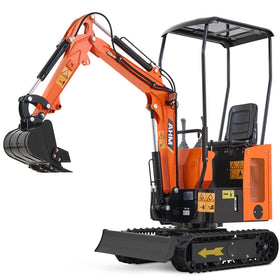
If you are just looking into buying your first mini excavator, or maybe you are just getting started in the world of mini excavators, one of the most important components you have to master is the hydraulic thumb.
In effect, a hydraulic thumb is what transforms a mini excavator from a digging machine into a powerful material-handling tool, and it dramatically increases productivity and expands the machine's capabilities, whether you are clearing brush, moving rocks, loading debris, or handling logs.
So, what exactly is a hydraulic thumb, and why does every mini excavator need it?

What Is a Hydraulic Thumb and Why Does a Mini Excavator Need One?
A hydraulic thumb is a metal attachment that is mounted to the stick(arm) of a mini excavator to work in conjunction with the bucket. It is powered by the machine's hydraulics, and it acts like a mechanical thumb (remember, it is attached to the arm), working with the bucket to grip and lift irregular objects like boulders, tree stumps, logs, broken concrete, etc.
Essentially, the hydraulic thumb on a mini excavator functions much like a human thumb does when paired with fingers. The excavator bucket acts as the fingers, while the thumb provides opposing force, allowing the machine to grasp objects securely.
It works together with the bucket, allowing the operator to grab, hold, lift, move, and place objects that would otherwise be difficult or impossible to handle safely.
Without a thumb, an excavator bucket can scoop material but struggles to hold irregular objects. Think of all the irregular material a mini excavator would have to pick up: scrap metal, pipe sections, demolition debris, etc. A standard bucket may be able to nudge or balance these items, but controlling them can be difficult and unsafe.
 Why Many Operators Consider a Hydraulic Thumb Essential
For many operators, a hydraulic thumb is a big game changer for property maintenance, landscaping, and cleaning, mainly because it completely eliminates the need to bend over and pick up heavy materials by hand. Common jobs where a hydraulic thumb shines include:
- Land clearing
- Brush removal
- Storm cleanup
- Demolition work
- Firewood handling
- Rock placement
- Fence removal
- Utility installation
Many mini excavator owners initially purchase their machine for digging projects, but after adding a hydraulic thumb, they often discover it becomes one of their most-used attachments. For example, after removing a tree stump, the operator can immediately grab the stump and load it into a trailer rather than leaving it on the ground and finding another machine to move it.
How a Mini Excavator Hydraulic Thumb Works and How to Use It Effectively
While a hydraulic thumb appears simple, it relies on the excavator's hydraulic system to create a significant gripping force. A hydraulic cylinder controls the movement of the thumb. The thumb is attached to the excavator stick, while hydraulic lines connect the cylinder to the machine's auxiliary hydraulic circuit.
When the operator activates the auxiliary controls:
- Hydraulic pressure extends the cylinder.
- The thumb rotates toward the bucket.
- The bucket and thumb are close together.
- The object becomes trapped between them.
The operator can then lift, move, and position the object. When the object reaches its destination, hydraulic pressure retracts the thumb, the grip releases, and the object is placed where desired.
Basically, it connects to the excavator's auxiliary hydraulic lines and is controlled via a button or switch in the cab (usually on the joystick or a foot pedal). To securely pinch items, you curl the bucket and close the thumb simultaneously to securely pinch items.
 Best Practices for Using a Hydraulic Thumb on a Mini Excavator
- Match the bucket and thumb properly: The bucket and thumb should mesh together effectively. Poorly matched components may reduce gripping performance and make handling awkward.
- Grab objects near their center of gravity: When lifting rocks, logs, or debris, try to grip the object near its center. This improves balance and reduces the risk of shifting loads.
- Avoid excessive clamping force. More pressure is not always better. Applying excessive force can damage materials, bend components, and stress hydraulic systems
- Keep loads low during transport: When moving material across a site, keep the load close to the ground whenever possible. This improves machine stability and reduces rollover risk.
- Use smooth movements: Sudden swinging or abrupt hydraulic movements can cause objects to shift or slip. Smooth, controlled operation improves both safety and precision.
Types of Mini Excavator Hydraulic Thumbs and How to Choose Between Them
Not all hydraulic thumbs are the same. There are several designs, and each is intended for different applications and operator preferences. However, the most popular ones are progressive link hydraulic thumbs, direct pin-on hydraulic thumbs, and pin-grabber (quick coupler) thumbs.
1. Progressive-Link Hydraulic Thumbs
Instead of mounting directly to the cylinder, a progressive link-style hydraulic thumb features an additional linkage bar connecting the cylinder to the thumb plate.
The main advantage of the progressive link hydraulic thumb is that it offers up to 180 degrees of rotation and follow-the-bucket motion. It provides excellent load control and allows the operator to easily grip complex objects closer to the machine.
The only setback with progressive-link hydraulic thumbs is that they are expensive, and that is mainly because of the added complexity and pins they include.
2. Direct Pin-On / Stick-Mounted Thumbs
These are directly welded to the excavator arm (dipper stick) and use a hydraulic cylinder to open and close. The advantage of direct pin-on hydraulic thumbs is that they are highly durable, very rigid for heavy lifting, and generally cheaper than linkage thumbs.
On the other hand, they tend to limit bucket-swapping. You must unbolt/remove the thumb to switch to different or larger bucket sizes. They also offer a narrower working range.
3. Pin-Grabber (Quick Coupler) Thumbs
Pin-grabber thumbs mount to a specialized quick coupler rather than directly to the excavator's stick. They are ideal for contractors or homeowners who frequently swap buckets. The thumb stays out of the way when you don't need it.
On the other hand, they can add extra length to your stick, sometimes requiring you to trim or extend the thumb to perfectly mesh with your bucket's teeth.
Choosing the Right Mini Excavator Hydraulic Thumb
| Operator Type | Typical Materials/Tasks | Recommended Thumb Features | Why It Works |
| Homeowners and Property Owners | General property maintenance, occasional debris removal, and small landscaping projects | Direct-link hydraulic thumb | Provides excellent versatility without high cost and is suitable for a wide range of occasional tasks. |
| Landscapers | Rocks, brush, small logs, decorative stone, landscaping materials | Hydraulic thumb with good gripping geometry and moderate reach | Offers the control and flexibility needed to handle irregular landscaping materials efficiently. |
| Demolition Contractors | Concrete, scrap metal, demolition debris, building materials | Heavy-duty construction, strong gripping force, reinforced thumb designs | Prioritizes durability and strength to withstand demanding demolition environments. |
| Tree Service and Land-Clearing Operators | Logs, stumps, brush, fallen trees, vegetation | Progressive-link designs, enhanced gripping capability | Provides superior control when handling large, irregularly shaped materials that can be difficult to secure. |
Hydraulic Thumb vs. Manual (Mechanical) Thumb
A mechanical thumb is manually adjusted into fixed positions. To change the thumb's position, the operator must park the machine, exit the cab, remove adjustment pins, reposition the thumb, and reinsert the pins. Once positioned, the thumb remains fixed. The bucket moves against the stationary thumb to grip objects.
- Mechanical thumbs offer a lower purchase price, simpler design, no additional hydraulic plumbing, and reduced maintenance requirements. For occasional use, they can be a cost-effective solution.
- Hydraulic thumbs, on the other hand, offer major productivity advantages. The operator can open and close the thumb from the cab, adjust grip size instantly, handle irregular objects more easily, and switch between digging and gripping without stopping. This dramatically improves efficiency.
In summary, while manual (mechanical) thumbs are cheaper, they require you to get out of the cab and pull a pin to adjust the angle. A hydraulic thumb is preferred because you can adjust the angle on the fly from the comfort of the cab, depending on the size of the object you are picking up.
 Final Thoughts on Mini Excavator Hydraulic Thumbs
A hydraulic thumb is one of the most useful upgrades available for a mini excavator. Working together with the bucket, it allows the machine to securely grab, lift, move, and place materials that would otherwise be difficult to handle. From land clearing and demolition to landscaping and storm cleanup, a hydraulic thumb dramatically expands what a mini excavator can accomplish.
Understanding how hydraulic thumbs work, the different designs available, and how they compare to mechanical thumbs helps operators choose the right setup for their needs. While mechanical thumbs can be effective for occasional use, hydraulic thumbs offer superior control, convenience, and productivity.
You may also be interested in how to install a hydraulic thumb on a mini excavator.