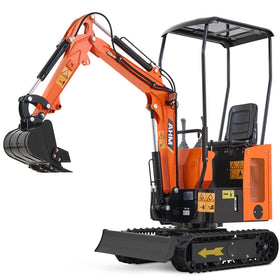
One of the most challenging aspects of owning or using a mini excavator is hauling it safely from place to place. This is why choosing the right trailer size is about much more than just “will it fit?” Your goal should be to get a trailer that safely supports the excavator’s weight, leaves room for attachments and accessories, maintains proper balance for towing, and stays within your truck’s towing limits and legal requirements.
A trailer that is too small may also leave no room for buckets, augers, or extra attachments, forcing you to transport equipment separately. On the other hand, an oversized trailer can add unnecessary weight, cost more, and be harder to maneuver on job sites or narrow roads.

What Size Trailer Is Best for a Standard Mini Excavator?
Choosing the best trailer size depends mainly on three things: the operating weight of the mini excavator, the physical dimensions of the machine, and whether you are hauling attachments with it. Most mini excavators fall into one of several common size categories.
1. Small Mini Excavators (1–2 Tons)
A 12-foot trailer is often the sweet spot for very small mini 1-2 ton excavators because it gives enough room to position the excavator properly for tongue weight balance without crowding the trailer. Small mini excavators weighing roughly 2,000–4,000 pounds are commonly hauled on 10-foot to 12-foot trailers, single-axle heavy-duty trailers, and lightweight tandem-axle trailers.
A 1-ton mini excavator, like the AX-15 Kubota Engine Mini Excavator, is compact enough that you usually do not need an oversized trailer. However, many operators still prefer tandem-axle trailers for better stability and safer highway towing.
2. Mid-Size Mini Excavators (3–5 Tons)
Mini excavators in the 6,000–12,000-pound range typically require 14- to 18-foot trailers, usually tandem dual-axle equipment trailers, and 10,000–14,000+ GVWR trailers.
For a standard 3.5-ton mini excavator, many users generally recommend a 7' x 14' or 7' x 16' tandem-axle trailer with at least a 14,000 lb (14k) GVWR.
This is the most common category for contractors and landscapers. A 14-foot trailer may technically fit the machine, especially if it is a more compact version like the AY-25 Perkins Diesel Engine 2.5 Ton Mini Excavator, but many operators prefer 16-foot or 18-foot trailers because they provide more flexibility for attachments and safer weight distribution.
3. Larger Mini Excavators (6–10 Tons)
Heavier mini excavators often need 18-foot to 20-foot trailers. Usually, these are heavy-duty equipment trailers, gooseneck or deckover trailers that have higher GVWR ratings.
Once you get into larger compact excavators, trailer capacity becomes just as important as deck length. Even if the machine physically fits, the trailer axles, brakes, frame, and tires must safely support the weight.
Mini Excavator Trailer Size Recommendation Chart
| Mini Excavator Size Range | Recommended Trailer Length | Trailer Type | GVWR Recommendation | Key Notes |
| Very small (1–2 ton excavators) | 12-foot trailer | Light equipment trailer | Varies (typically lower GVWR setups) | Often considered the “sweet spot” for small machines |
| Small to mid-size (6,000–12,000 lbs) | 14–18 feet | Tandem dual-axle equipment trailers | 10,000–14,000+ lb GVWR | Common range for general mini excavator transport |
| Standard 3.5-ton mini-excavators | 7' x 14' or 7' x 16' | Tandem-axle equipment trailer | Minimum 14,000 lb (14k) GVWR | Widely recommended setup; offers a good balance of length and weight capacity |
| Heavier mini-excavators | 18–20 feet | Heavy-duty equipment trailers, gooseneck, etc | Higher GVWR ratings (typically above 14,000 lb) | Required for larger machines; provides extra length and strength |
Recommended Mini Excavator Trailer Size Specifications
- Ideal trailer dimensions: A 14-foot length is often considered the bare minimum for a mini excavator. A 16-foot or 18-foot deck allows for better load balancing and space for extra buckets or attachments.
- Best weight capacity (GVWR): 14,000 lb (14k) is the most common recommendation for 3.5-ton machines. It provides enough buffer for the machine (~8,000 lbs), the trailer weight (~3,000–4,000 lbs), and accessories.
- 9k or 10k axles: For those moving equipment daily, it is better to upgrade to tandem 10,000 lb axles for better durability and safer braking. Always choose a dual-axle system with brakes. Single-axle trailers are generally only suitable for tiny machines under 1.5 tons.

Mini Excavator Trailer Sizes With Attachments
Whether you are hauling the mini excavator with or without attachments determines the size of trailer you need. A mini excavator with a single bucket may fit perfectly on a 14-foot trailer, but once you add other mini excavator attachments like augers, hydraulic breakers, extra buckets, grapples, pallet forks, etc., you may suddenly need several extra feet of usable deck space.
Many contractors move from a 14-foot trailer to a 16-foot trailer specifically so they can haul the excavator, a trenching bucket, a grading bucket, and even small tools, all in one trip. The extra length is less about the physical footprint of the attachments and more about having enough room to shift the machine's position to maintain proper weight distribution.
Recommended Trailer Sizes for Mini Excavators With Attachments
| Trailer / Capacity Option | Recommended Use Case | Key Notes |
| 18-foot deck | Best “sweet spot” for a single 3.5-ton machine with 1–2 extra buckets | Offers balanced size and maneuverability while still leaving room for a couple of common attachments |
| 20-foot+ deck | Ideal for operators frequently carrying larger attachments like a brush cutter, hydraulic hammer, or auger drive | Extra deck length lets you keep attachments secured at the front while properly positioning the excavator over the axles for safe weight distribution |
| 14,000 lb GVWR (minimum) | Minimum recommended rating even for smaller machines | Attachments add weight quickly—items like buckets and augers can add 200–500 lbs each, significantly increasing total load requirements |
Trailer Setup Tips for Hauling Mini Excavators with Attachments
- Fixed Front Section: If you are using a tilt trailer, consider a "split tilt" design with a 4–6-foot fixed deck at the front. This provides a stable area to chain down buckets and tools while the machine is on the tilting portion.
- Attachment Racks: If you own the trailer, consider welding custom bucket teeth holders or shelves on the front of the trailer to keep the deck clear.
- Nesting Buckets: To save space, you can "nest" smaller buckets inside larger ones (like a 12" bucket inside a 36" grading bucket) and use a single heavy-duty chain or strap to secure both together.

Common Types of Trailers for Mini Excavators
Not every trailer style works equally well for hauling excavators. Some excel at maneuverability, while others are built for heavy-duty commercial hauling.
- Equipment flatbed (with ramps): The standard and most cost-effective choice for hauling a trailer. It is recommended to add rebar to ramps for better traction during wet weather.
- Tilt deck trailers: Tilt-deck trailers are favored for ease of loading since you don't have to mess with heavy ramps. A split tilt (with a fixed front section) is a popular premium option for carrying extra gear.
- A dump trailer: A popular "two-birds-one-stone" option. While versatile for hauling dirt and gravel, loading can be tight, and tie-down points are often less convenient than on flatbeds.
Key Safety Tips for Hauling a Mini Excavator
1. Critical Safety: The "10k Rule."
If your combined machine and attachment weight exceeds 10,000 lbs, the Department of Transportation (DOT) rules typically require a minimum of four direct tie-downs (one on each corner) plus additional securement for every attachment.
| Component | Securement Recommendation |
| Excavator | 4 heavy-duty chains (one per corner). |
| Boom/Bucket | Must be lowered to the deck and secured with a separate strap or chain. |
| Loose Buckets | Chain through the pinholes or use heavy-duty ratchet straps. |
2. Check Your GVWR
The trailer’s GVWR (Gross Vehicle Weight Rating) must exceed the fully loaded weight of the excavator and attachments.
You also need to verify the towing capacity of the tow vehicle, its hitch rating, axle ratings, and tire load ratings. Your truck, trailer, and hitch all need to work together as a system.
3. Balance the Load Properly
Use the “60/40 Rule”: Position the machine so that 60% of the weight is toward the front of the trailer to ensure proper tongue weight and prevent dangerous swaying. The excavator should usually sit slightly forward of the trailer axles while still maintaining balanced weight distribution.
4. Secure the Machine Correctly
Mini excavators should always be secured using heavy-duty chains, rated binders, and proper tie-down points. Do not rely solely on the parking brake or hydraulics.
For tie-downs, ensure the trailer has heavy-duty D-rings.
For dump trailers, double-check that the tie-down points are robust enough for heavy machinery
5. Inspect Tires and Brakes
Trailer tires and brakes take enormous stress when hauling equipment. Before every trip, check tire pressure, inspect tread wear, test the trailer’s brakes, and verify the lights are working. Trailer tire failures are one of the most common causes of hauling accidents.
6. Load on Stable Ground
Whenever possible, load on level firm ground, with the ramps aligned. Fast loading creates unnecessary risk, especially with tracked equipment.
 Final Thoughts on Mini Excavator Trailers
The best trailer size for a mini excavator is usually slightly larger than the bare minimum required to fit the machine. Extra deck space gives you flexibility for attachments, safer weight distribution, and easier loading.
For many operators, a 14-foot to 16-foot tandem-axle equipment trailer hits the sweet spot for standard mini excavators. Larger machines or crews hauling multiple attachments often benefit from stepping up to an 18-foot trailer, deckover, or gooseneck setup.
Capacity, stability, balance, attachment storage, and towing safety all matter just as much as whether the excavator physically fits on the deck. A properly matched trailer makes hauling safer, smoother, and far less stressful every time you head to a job site.
You may also be interested in our complete guide on how to transport a mini excavator safely and legally.