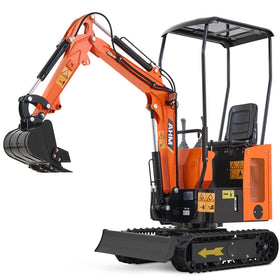
When you are thinking about starting a mini excavator business, your goal shouldn’t just be to “find work”; it should be to choose a niche that gives you consistent demand, manageable startup costs, and room to grow.
Mini excavators are extremely versatile, but that doesn’t mean every job is equally profitable or easy to break into. When choosing a mini excavator business, the smartest move is to focus on services where:
- Demand is steady
- Competition isn’t overwhelming
- A small machine can still deliver big value
Let’s go through five business ideas that check those boxes and actually make sense to start.

Top 5 Mini Excavator Business Ideas
1. Specialized Trenching
Trenching is always in demand for drainage systems, irrigation lines, and electrical and plumbing runs. These are recurring needs in both residential and light commercial projects, which means steady work.
How to get into the Specialized Trenching Business
- Partner with plumbers, electricians, and landscapers
- Offer fast turnaround trenching services
- Start with smaller residential jobs and build referrals
This is one of the easiest entry points because it requires skill and precision more than heavy equipment investment. You don't need a massive mini excavator: accuracy matters more than raw power. All you need is a 1–3 ton mini excavator with good precision control and a narrow bucket attachment.
Learn how to choose a mini excavator trenching bucket for business use.
 2. Small Demolition and Cleanup
There’s constant demand for demolition and cleanup projects like shed removal, concrete breaking, and fence and deck demolition. Homeowners and contractors often need small-scale demo work that’s too minor for large crews.
How to get into the small demolition and cleanup business:
- Market to homeowners and small contractors
- Offer package deals (demo + cleanup)
- List services locally (Facebook Marketplace, Craigslist, etc.)
The key here is convenience; people want someone who can tear it down and haul it away.
To get into the small demolition business, you need a 2–5 ton mini excavator machine and one or two attachments: a hydraulic thumb attachment (essential), and a breaker/hammer attachment (optional). The thumb alone can dramatically increase your efficiency.
3. Landscaping and Site Prep
What makes landscaping and site prep a fantastic business idea is that landscaping projects are everywhere: grading yards, preparing driveways, leveling ground for patios or sheds. This type of work is especially consistent in growing suburban areas.
How to Get Into the Mini Excavator and Site Prep Business
This niche is great because it combines high demand with relatively low barriers to entry. To get into it, consider these three tips:
- Partner with landscapers who don’t own equipment
- Offer prep services before installations
- Build a portfolio with before-and-after results
Choosing the best mini excavator for the job
When choosing a mini excavator for landscaping, you want a machine that prioritizes precision and finish quality. A 1–4-ton mini excavator with smooth hydraulic control should suffice, especially if you pair it with grading buckets or tilt buckets.

4. Utility and Footings Work
Construction always needs footings for small structures, utility line digging, and foundation prep. Even small contractors often outsource this work.
To get into the utility and footings work business, network with general contractors and builders, offer reliable scheduling (this is huge in construction), and start with small residential builds.
Consistency and reliability matter more than anything here: contractors will rehire you if you show up and deliver.
5. Land Clearing (Light to Moderate)
Land clearing is a good and reliable mini excavator business because clearing is always the necessary first step before any development. Property owners frequently need services like brush removal, small tree clearing, and lot preparation.
To get into the land clearing business, target rural property owners and developers, offer clearing packages by area (per acre or lot), and bundle services (clearing + grading) if you can.
This business can become very profitable as you scale, especially if you expand into larger equipment later.
For land clearance, you need a mini excavator with enough power to handle the roots and thicker vegetation. Go for a 4–6 ton mini excavator, a thumb attachment, and (optional) a brush cutter or grapple.
Learn more about starting a land clearing business with a mini excavator.

AHM's Mini Excavator for Business
The AHM AX-15 Excavator combines Kubota's proven D722 diesel engine with a 1.1-ton compact excavator platform designed specifically for residential and light commercial applications.
At 1,940 pounds operating weight and 36 inches wide, it's the narrowest Kubota engine mini excavator in the AHM lineup, fitting through gates and accessing backyards that larger diesel excavators can't reach.
The Kubota D722 engine provides 13.8 HP (10.1 kW) at 2,600 RPM through a three-cylinder, water-cooled diesel design. This engine has powered industrial equipment for over 25 years, establishing reliability benchmarks across agricultural machinery, construction equipment, and utility vehicles.
The AX-15 delivers 2,698 lbf digging force and 69-inch maximum digging depth, matching the performance of gasoline-powered 13.5 HP models while providing diesel's longevity advantage. The 120-inch maximum digging radius provides a 10-foot horizontal reach from the machine's center position.
Key Tips for Success in the Mini Excavator Business
Starting in the mini excavator business is one thing; staying profitable is another. These tips will help you build something sustainable.
1. Do a Lot of Subcontracting
Reach out to local General Contractors (GCs) and builders to handle smaller jobs that they do not want to do. When you contact local contractors and landscapers, offer your services as a reliable operator and focus on being easy to work with and dependable.
Subcontracting gives you immediate work, a consistent income, and much-needed industry connections. A lot of successful operators start this way before going fully independent.
2. Price for Profit, Not Just to Win Jobs
When pricing mini excavator projects, focus on long-term sustainability, not just short-term success.
- Factor in fuel, maintenance, transport, and time
- Charge for your expertise, not just machine time
- Offer value (speed, reliability, quality), not just low prices
It’s tempting to undercut competitors, but that leads to burnout, equipment wear without return, and no room to grow. Most entrepreneurs adopt a hybrid model (i.e., hourly rate+mobilization fee) or a flat rate for defined jobs.
 3. Focus on Efficiency and Maintenance
Your machine is your income source. Downtime equals lost money. Learn to perform field repairs every day to reduce overhead costs, and maintenance can be high. Also, adopt the following practices:
- Stick to a strict maintenance schedule
- Keep spare parts and fluids on hand
- Plan jobs to minimize unnecessary movement and fuel use
Efficient operators make more per day, even at the same rates.
4. Niche Down Instead of Doing Everything
Do not try to do everything; instead, focus on one area (e.g., demo) so you can build a portfolio and gain momentum. Start broad, then focus on what’s most profitable.
Then:
- Build a reputation in one or two services
- Become the “go-to” person for that niche
Specialization often leads to higher-paying, repeat clients. Trying to do every type of job makes it harder to market yourself, build expertise, and stand out.
5. Get the Right Equipment (Not Just More Equipment)
It’s easy to overspend on machines and attachments you don’t actually need. For a mini excavator business, what you really need is the mini excavator itself, a truck, and a trailer.
- Start with a versatile mini excavator
- Add attachments based on demand (thumb, auger, breaker, etc.)
- Upgrade only when your workload justifies it
The goal is to maximize ROI, not just expand your inventory. Starting small with a compact track loader is a viable alternative if funds are low.
 Final Words on Mini Excavator Businesses
Starting a mini excavator business isn’t about having the biggest machine; it’s about choosing the right work and executing it consistently.
If you focus on high-demand services like trenching, landscaping, and demo, building relationships through subcontracting, and running your operation efficiently, you can turn a single mini excavator into a steady, scalable income stream.
Start simple, stay consistent, and grow based on real demand: that’s how you build something that lasts.
You might also want to explore this guide on pricing mini excavator work and why appropriate pricing is essential for building a sustainable, profitable business.