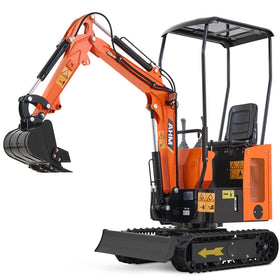
When setting the price for mini excavator work, the most important thing to keep in mind is that the goal is to charge a rate that is both appropriate for the work you are doing and still sustainable for your business over the long term.
This is where some operators get it wrong: trying to get more business, they charge prices that are too low, and get more business initially, but end up losing money in the long run.
As obvious as this may be, mini excavators are quite expensive machines, and the real costs of operating them (think about maintenance, transport, insurance, fuel, wear and tear, etc.) add up quickly.
This is something you should remember when pricing your work.

How Mini Excavator Work is Priced
The best strategy for determining how much to charge for mini excavator work is to start by understanding how excavator work is typically priced, and then use that as a baseline to build a system that keeps your business profitable while remaining competitive in your market.
Most mini excavator projects are priced using one of three common methods:
- Hourly rates
- Daily rates
- Project-based (flat) pricing
Among these, hourly pricing is by far the most common, especially for small excavation contractors or owner-operators.
1. Pricing By Hourly Rates
Many mini excavator operators charge between $75 and $150 per hour, depending on the size of the machine, their location, level of experience, the type of work, and whether or not the operator is included.
Here is a breakdown of the typical hourly rates for mini excavator work:
- Mini excavator with operator: $90 – $150 per hour
- Mini excavator only (rare): $60 – $100 per hour
- Minimum job charge: Often 2–4 hours
Hourly pricing is popular because excavation work can be unpredictable. Soil conditions, rocks, tree roots, and site accessibility can all affect how long a job takes.
2. Charging by Daily Rates
For longer projects, some contractors charge daily rates instead of hourly. Typical daily rates can vary between $600 – $1,200 per day, again depending on the size of the machine, location, experience, type of work, and whether or not the operator is included.
Daily rates are often used when:
- The project will take a full day or more
- The scope is somewhat predictable
- The contractor wants to simplify billing
Project-Based Pricing
Flat-rate pricing is common for very specific mini excavator jobs like digging a trench, stump removal, small foundation excavator, drainage installation, etc.
The rate differs depending on the project, and it may look something like this:
- $400 for a small trench
- $800 for stump removal
- $1,500 for backyard grading
This method works best when you have experience estimating how long the job will take.

How to Determine How Much to Charge for Mini Excavator Work
The standard approach for setting a fair and profitable price for mini excavator work is to calculate the rates based on five key factors:
- Cost of the equipment (mini excavator + attachments)
- Cost of fuel
- Labor cost (operator cost)
- Transportation cost
- Overhead costs
1. Equipment Cost
For many operators, the total works out to $20–$40 per hour for equipment cost. A few operators charge a base price for the mini excavator and bucket, and add a percentage charge for additional attachments that may be needed for the job.
- A hydraulic thumb attachment, for example, could cost an additional 5% per hour.
- A twist bucket may be an additional 10%, etc.
The rationale for this pricing is that the machine itself might cost anywhere from $25,000 to $90,000, depending on the size and brand, and you need to recover costs such as loan payments, depreciation, hydraulic components, etc
A common rule is that equipment should generate enough revenue to pay for itself over time.
2. Fuel Costs
It is very important to know how much fuel your mini excavator uses. Mini excavators typically burn 1 to 3 gallons of diesel per hour, depending on size and workload. If diesel costs around $4 per gallon, fuel expenses may look like:
$4 – $12 per hour
Many operators round this up and include $10–$15 per hour in their pricing to cover fuel fluctuations.
3. Operator Labor
Your time has value. Even if you're the owner, your labor should be factored into the price. You can consider labor cost as the opportunity cost. Typical operator rates range from $30 – $50 per hour
If you are highly skilled or doing specialized work like grading or drainage installation, your labor value may be higher.
You can also base your prices on the minimum hourly wage in your state/city.
4. Transportation Costs
Transporting a mini excavator to the job site often requires a trailer, a truck, fuel, and time spent loading and unloading, and this can be a major cost for a distant project.
Many contractors charge a $50 – $150 delivery fee, or
Include travel time in the hourly rate.
5. Overhead and Business Costs
Running an excavation business also includes expenses such as insurance, business licensing, advertising, equipment storage, and tools. These costs often add $10 – $30 per hour to your operating expenses.
Charging for Mini Excavator Work: Example Rate Breakdown
A typical hourly rate might look like this:
| Cost Category | Hourly Cost |
| Equipment | $30 |
| Fuel | $10 |
| Labor | $40 |
| Overhead | $20 |
| Total Cost | $100/hour |
To make a profit, many contractors add a 20–40% margin, bringing the final rate to about $120 – $140 per hour. This aligns closely with what many mini excavator operators charge in real-world markets.

Other Ways to Charge for Mini Excavator Projects
While hourly pricing is common, some projects are better priced using alternative methods.
1. Charging by the Acre
For land clearing or grading, contractors sometimes charge by the acre. This typically ranges from $500 - $3,000 per acre, depending on factors like the density of the vegetation, how difficult the terrain is, the number of obstacles, and so on.
This method works best for larger land preparation projects where estimating hours may be difficult.
2. Charging Based on Excavator Rental Prices
Another simple pricing strategy is to base your rate on equipment rental costs. Some contractors charge double or triple the rental price to cover the operator, transportation, fuel, and business expenses.
A mini excavator rental might cost $300 – $500 per day. So if a machine rents for $400 per day, the service rate might be:
$800 – $1,200 per day
This approach provides a quick pricing benchmark.
3. Charging Based on Project Type
Some contractors develop standard prices for common jobs, such as:
- Trenching: $5 – $15 per linear foot
- Stump removal: $150 – $500 per stump
- Small foundation digging: $1,000 – $3,000
- Backyard grading: $500 – $2,000
This method works well when you have completed similar jobs many times and know exactly how long they usually take.
Tips for Determining How to Charge for Mini Excavator Projects
Pricing excavation work becomes easier as you gain experience, but a few practical tips can help you start on the right track.
1. Start With Hourly Pricing
If you're new to mini excavator work, hourly pricing protects you from underestimating job complexity. Unexpected problems, like buried rocks or utility lines, can dramatically extend a project.
2. Set a Minimum Job Charge
Small projects can still require travel and setup time. Many operators set a minimum charge of $200–$400 or a two- to four-hour minimum.
3. Evaluate Site Conditions Carefully
Before giving a quote, consider the soil type, access to the work area, obstacles (like fences or trees), depth requirements, material removal, and so on. These factors greatly affect how long the job takes.
4. Research Local Market Rates
Excavation pricing varies by region. Before setting your rates, check local contractors, equipment rental companies, and small excavation services in your area. This helps ensure your rates are competitive.
5. Always Leave Room for Profit
One of the biggest mistakes new operators make is underpricing their work. Your machine will eventually need repairs, tracks, hydraulic parts, and replacements.
A sustainable price ensures you can better maintain your equipment, replace aging machines, and grow your business.
 Final Thoughts on Pricing Mini Excavator Work
Charging for mini excavator work is about understanding the real costs of operating your equipment and running your business.
Most contractors charge $90 to $150 per hour, but the right rate depends on your equipment, experience, location, and the type of projects you handle.
By carefully considering equipment costs, fuel, labor, transportation, and overhead, you can build a pricing system that keeps your mini excavator business profitable while still offering competitive rates.
Explore our guide on 5 ways to make money with a mini excavator for some mini excavator business ideas that will help you generate more income.