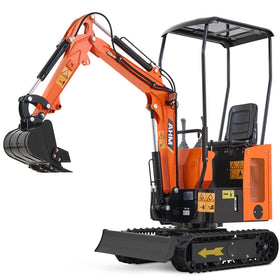
The best mini excavators for landscaping strike the balance between digging depth, width restrictions, and attachment compatibility without costing an arm and a leg.
A 1-ton mini excavator would save you about $3,000 upfront, but for landscaping, it lacks the force to rip through root systems. A 6-ton excavator, on the other hand, would be a massive overkill, delivering power you don't need for garden beds and residential grading work.
So, what size mini excavator do you need for landscaping? And what key features should you be looking for? Here’s everything you should consider when picking the best landscaping mini excavator.

Best Mini Excavator Size Classes for Landscaping
1. 1-2 ton class (2,000-4,000 lbs):
1-2 ton class mini excavators are ideal for handling residential landscaping projects of all sorts, from garden bed excavation, tree planting, small pond construction, and irrigation trenching. A typical 1-2 ton mini excavator features the following, all of which make it the best for landscaping:
- Digging depth: 60-80 inches.
- Digging force: 2,200-2,800 lbf.
- Width: 36-39 inches.
- Lifting capacity: 220-350 lbs.
1-2 ton mini excavators are more maneuverable, generally more affordable, and best for residential projects under 1 acre with gate access requirements.
2-3 ton class (4,000-6,000 lbs):
2-3 mini excavators are ideal for landscaping projects that are larger than a 1-ton mini excavator can handle.
Many professional landscaping companies working with commercial landscaping and multi-acre residential properties chose 2-3 ton mini excavators, as they have enough power for tasks like stump removal (12-16 inch diameter), retaining wall excavation, and larger pond construction (15-20 feet diameter).
- Digging depth: 80-100 inches.
- Digging force: 3,000-4,500 lbf. Width: 39-48 inches.
- Lifting capacity: 400-700 lbs.
3-5 ton class (6,000-10,000 lbs):
3-5 ton class mini excavators are generally used for massive projects beyond the scope of landscaping, but may only be used for heavy landscaping work like large stump extraction (18-24 inches), commercial grading projects, hillside terracing, and boulder placement.
- Digging depth: 100-120 inches.
- Digging force: 5,000-8,000 lbf.
- Width: 48-60 inches.
- Lifting capacity: 800-1,500 lbs.

What Makes a Mini Excavator Great for Landscaping? Must-Have Features
Landscaping requires a mini excavator that is compact, but versatile and compatible with a multitude of attachments. In addition, it must be well equipped to work on lawns and other comparatively “fragile areas” where landscaping typically takes place.
The following Features are crucial for a mini excavator for landscaping:
1. Zero or Minimal Tail Swing
For landscaping, it is important that the counterweight stays within track width during rotation, letting you work against walls, fences, and structures without repositioning. Standard tail swing excavators need 3-4 feet of rear clearance, which would be impossible in most residential backyards.
2. Rubber Tracks for Safe Use
Rubber tracks are a must-have feature in a mini excavator for landscaping, as they prevent turf damage on lawns and finished landscapes.
Steel tracks would tear grass and leave ruts that take weeks to repair, and may cause other problems. A mini excavator with rubber tracks distributes the weight across a larger surface area, reducing ground pressure to 3-5 PSI versus 8-12 PSI for wheeled equipment.
3. Compact Width for Maneuverability
For landscaping, you need a mini excavator with a size of about 36-39 inches that fits through standard residential gates (typically 42-48 inches). Anything wider requires removing fencing or accessing from the street, adding hours to setup time.
4. A Digging Depth of About 60-90 Inches:
A mini excavator with a digging depth of 60-90 inches covers most landscaping requirements, from planting holes (24-36 inches), drainage trenches (36-48 inches), and pond excavation (48-72 inches). Deeper than 90 inches is rare in landscaping applications.
5. Hydraulic Thumb Compatibility
A hydraulic thumb is essential for material handling tasks in landscaping. This is typically gripping rocks, moving boulders, positioning landscape timbers, and loading debris. A thumb transforms a digging-only machine into a versatile grapple tool.
5. A Quick-Attach Coupler System
Landscaping jobs require frequent attachment changes - grading bucket for leveling, trenching bucket for irrigation, auger for tree planting. Switching between buckets, augers, and other attachments takes 30-60 seconds versus 5-10 minutes manually removing pins.
6. Auxiliary Hydraulic Flow
Powers attachments like hydraulic breakers (removing concrete), augers (drilling post holes), and brush cutters (vegetation clearing). Insufficient flow rate makes attachments operate sluggishly or not at all.

Key Factors to Consider When Choosing the Best Mini Excavator For Landscaping
1. Start by Accounting for Access Constraints
Measure the narrowest gate, doorway, or passage on properties you service regularly. Add 2-3 inches of clearance, as a 42-inch gate requires a maximum 39-inch excavator width.
Also consider transport requirements. Mini excavators under 3,500 lbs tow behind half-ton trucks; heavier models need trailers and three-quarter-ton or larger vehicles.
2. Consider the Nature of Your Primary Landscaping Jobs
If 70% of your work involves residential garden beds, irrigation, and light grading, a 1-2 ton machine handles it. If you regularly remove large stumps, excavate commercial retention ponds, or grade for hardscaping, step up to 2-3 tons minimum.
3. Consider Ground Conditions
Soft, finished lawns require low ground pressure. Go for a lighter mini excavator (under 2,500 lbs), and ensure it has rubber tracks to minimize turf damage.
If you are working on rocky, compacted soil, go for a mini excavator with a higher digging force (about 2,800+ lbf minimum), so it can penetrate without constant repositioning.
3. Consider Compatibility with Attachments
Verify hydraulic flow rates support the excavator attachments you'll use. Augers need 10-15 GPM, hydraulic breakers require 12-18 GPM, and brush cutters demand 15-20 GPM. Insufficient flow makes attachments underperform.
4. Operating Hours and Durability Requirements
For a landscaping company, you need a mini excavator with a diesel engine (Kubota or Yanmar) that is capable of running equipment 30+ hours weekly and can exceed 5,000-hour service intervals.
If you mainly work on the weekend, or if you are a homeowner with under 200 annual hours, a mini excavator with gasoline engines with 1,500-2,500-hour lifespans will do for your projects.
5. Budget and ROI
Calculate the cost per operating hour over 5 years. A $5,500 gasoline model running 150 hours annually costs $7.33/hour (including fuel, maintenance, depreciation).
An $8,200 diesel model at the same usage costs $6.85/hour despite a higher purchase price due to lower fuel consumption and longer lifespan.

AHM Mini Excavators for Landscaping
AHM AX-15 - $8,199.99
The AX-15 runs a Kubota D722 diesel engine that outlasts gasoline engines by roughly three times - 5,000-7,000 hours versus 1,500-2,500 hours. At 36 inches wide, it's the narrowest in the AHM lineup, fitting through tight residential gates while delivering 2,698 lbf digging force.
The 69-inch digging depth covers most landscaping applications from irrigation trenching (24-36 inches) to pond excavation (48-60 inches).
AHM AX-16S - $8,599.99
The AX-16S features a retractable undercarriage adjusting from 39 inches (3'3") to 47.2 inches (3'11") in width. Narrow the tracks for gate access and residential pathways, then expand for stability when lifting heavy materials or working on slopes.
The 23 HP Briggs & Stratton dual-cylinder engine delivers 70% more horsepower than 13.5 HP models, providing 2,923 lbf of digging force.
Choosing the Best Mini Excavators for Landscaping: Tips
Selecting the right mini excavator for landscaping will determine whether your crew completes jobs profitably or wastes hours repositioning equipment and working around limitations.
Landscaping work demands precision in confined residential spaces, and the wrong machine either can't physically access the site or damages property trying to maneuver.
A mini excavator for landscaping has to handle diverse tasks: excavating ponds 10-15 feet across and 3-4 feet deep, trenching for irrigation systems without destroying lawns, removing stumps 10-18 inches in diameter, grading terrain for patios and walkways, clearing brush and vegetation, and installing retaining wall foundations.
Your machine needs enough power for the toughest regular task while staying compact enough for the tightest access point you encounter.

Final Thoughts
The best mini excavator for landscaping should match your most frequent job requirements without overpaying for capacity you won't use.
Most professional landscapers will find the 1.5-2.5 ton range narrow enough (36-40 inches) for residential gate access, powerful enough (2,500-3,000 lbf) for stump removal and pond excavation, and light enough (under 5,000 lbs) for most sites. Consider these factors when picking the perfect mini excavator for you, and don’t forget to check out the AHM range for some great picks.