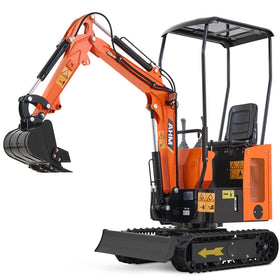
A mini excavator with just a bucket handles basic digging, but swap on a hydraulic breaker, and suddenly you're crushing concrete. The right mini excavator attachments turn one machine into a complete jobsite toolkit; the trick is knowing which attachment does what and whether your excavator can actually run it.
This mini excavator attachment guide walks through the attachments you'll actually use, what makes them work, and how to avoid buying something that won't fit your machine.

Digging and Trenching Attachments
1. Standard Digging Buckets
Mini excavator digging buckets are your defaults for general excavation, loading trucks, and moving material. Mini excavator digging bucket widths run 12-24 inches for 1-2 ton excavators with capacities from 0.88-4.1 cubic feet.
- Match the bucket width to excavator weight (2,000 lb machine = 12-16 inch bucket)
- Pin diameter: 0.98-1.18 inches
- Pin spacing: 3.54-3.66 inches standard for small machines
- Reinforced buckets with replaceable teeth last 2-3 times longer, cost $300-800 more
2. Trenching Buckets
Narrow buckets (6-12 inches wide) cut precise trenches for pipes, electrical lines, and drainage. The AHM 200mm trenching bucket runs 8 inches wide and weighs 37.3 pounds, digging clean utility trenches without pulling up half your yard.
- Deeper buckets (13-16 inches) make cleaner trenches with less cleanup
- Manganese steel resists abrasion 3-5x better than regular steel in clay
- Pin spacing must match exactly (AHM uses 3.62-inch span with 0.98-inch pins)
3. Grading Buckets
Mini excavator grading buckets are wide, shallow mini buckets (36-60 inches) with smooth edges for final grade work. Typical capacities run 3.45-15.7 cubic feet. The smooth cutting edge creates level surfaces without bucket tooth marks.
Typical Features/Specs
- 48-inch bucket with 120-inch reach = 40% coverage per pass
- Struck capacity vs heaped: buckets with 64% more heaped capacity cut passes by nearly half
- Smooth edge is essential for driveways, parking lots, and building pads
4. Tilting Buckets
Mini excavator tilting buckets pivot 45 degrees left and right using hydraulic cylinders, grading slopes without constant repositioning. They are usually available in 24-60 inch widths.
Typical Features/Characteristics
- Single-cylinder for 24-36 inch buckets (1.5-4.5 ton excavators)
- Dual-cylinder for 36+ inch buckets on heavier machines
- Requires auxiliary hydraulics on your excavator
- Cost: $1,500-3,500 vs $400-900 for standard grading buckets
 Land Clearing and Vegetation Attachments
1. Root Rakes
Mini excavator root rakes have teeth spaced 4-6 inches apart that grab roots and rocks while letting dirt fall through. One pass separates the material.
Typical Features/ Characteristics
- 6-inch spacing: catches 3+ inch roots/rocks
- 4-inch spacing: grabs smaller debris, fills faster
- Deeper rakes (24+ inches): more leverage for stubborn roots
With its precise dimensions, the AHM 19.3" Mini Excavator Rake Attachment comes with 2 hinge pins and nuts for swift and easy installation, minimizing downtime. Crafted from durable manganese steel, it provides excellent wear and rust resistance, making it reliable for demanding tasks, whether it's agriculture, construction, or landscaping.
2. Ripper Teeth
Mini excavator ripper teeth are single hardened steel point tjat concentrate digging force to break frozen ground, compacted soil, and weathered rock. Generates 3-5x more penetration than bucket teeth.
Typical Features
- Hardened steel (HRC 50-55): lasts 500-800 hours in rocky conditions
- Mild steel: wears out in 100-200 hours
- Pin-on rippers: swap in 2-3 minutes
- Weld-on: permanent until cut off
The AHM ripper attachment is pointed end easily penetrates tough or frozen terrains such as rock, shale, or permafrost, creating holes or breaking up surfaces without damaging the surrounding area. Designed for perfect compatibility with AHM and various mini excavators up to 2 tons, it ensures a seamless fit.
3. Mulching Heads
Rotating drums with knives grind brush and small trees into mulch. The Loftness Battle Ax runs 25 inches wide on 7,000-10,000-pound excavators, handling trees up to 6 inches thick.
- Require 15-35 GPM hydraulic flow (standard mini excavators: 10-20 GPM)
- 25-inch width: clears 0.5-0.75 acres daily
- 40-inch width: clears 1-1.25 acres daily
- Drum speed: 1,750-2,300 RPM
 Demolition and Breaking Attachments
1. Hydraulic Breakers
Mini ecavator hydraulic hammers deliver 500-1,200 blows per minute to break concrete, asphalt, and rock. Match the breaker weight to 10-15% of the excavator's operating weight: for example, a 2,000-pound excavator needs around 200-300 pounds.
The AHM unit at 165.3 pounds fits perfectly.
- Flow requirements: most mini excavator breakers need 8-18 GPM
- Too little flow cuts impact power by 30-50%
- BPM choice: 500-800 for precision work, 1,000-1,200 for heavy concrete
- Breaker eliminates $200-400 daily rental costs after 4-8 uses
2. Crushers
Mini excavator crushers are claw-style crushers that use hydraulic pressure to crack concrete and stone into smaller pieces.
- 12-inch jaw openings: handle residential concrete (4-6 inches thick)
- 18+ inch openings: tackle commercial foundation work
- 30-50 tons crushing force: processes 0.5-1 cubic yard per hour
Material Handling Attachments
1. Grapples
Mini excavator hydraulic claws open and close to grab logs, rocks, brush, and debris. Here's what to look for:
- Serrated edges grip round logs better than flat claws
- Pin diameter (0.98-1.57 inches) must match bucket mounts
- Weight affects lifting capacity (AHM grapple: 52.9 pounds)
2. Hydraulic Thumbs
Works with your bucket like an opposing thumb, pinching irregular objects. The AHM Hydraulic Thumb runs 22 inches long with serrated edges, fitting 1-2 ton excavators with 3.6-inch mounting hole spacing.
What to look for:
- Thumb length: 70-85% of bucket width for good grip
- Hydraulic operation: adjusts continuously, needs 4-8 GPM
- Mechanical thumbs: lock in 2-3 fixed positions
- Serrated edges stop smooth materials from slipping
 Finishing and Landscaping Attachments
1. Grading Beams
Adjustable blades spanning 6-12 feet for precise grade control.
- 6-8 foot beams: residential driveways, small pads
- 10-12 foot beams: commercial parking lots
- Laser-guided: holds grade within 0.25 inches automatically
- Manual systems: require constant adjustment
2. Compaction Wheels
Cylinder-shaped attachments that roll and compress soil, gravel, and base material.
- Static wheels (300-800 lbs): 85-90% compaction in 3-4 passes
- Vibratory wheels (2,000-3,000 VPM): 92-95% compaction in 2-3 passes
- Standard drum width: 24-36 inches for mini excavators
Tips for Choosing the Best Mini Excavator Attachments
Match hydraulic requirements: Your excavator's auxiliary hydraulic flow (GPM) and pressure (PSI) must meet or exceed attachment needs. Underpowered machines lose 40-50% of attachment power.
Get a quick coupler: Swaps attachments in 30-60 seconds versus 10-15 minutes manually. The AHM quick hitch ($149.99) pays for itself after 20-30 attachment changes.
Buy for common jobs:
- Trenching weekly? Trenching bucket saves 30-45 minutes per job
- Breaking concrete monthly? Breaker eliminates $200-400 daily rental after 4-8 uses
- Moving the brush regularly? Grapple cuts manual labor by 60-70%

Conclusion
Understanding attachments for mini excavator work means matching hydraulic capacity (check GPM and PSI), verifying mounting specs (pin diameter and spacing), and buying for your most common jobs rather than trying to handle everything with one machine.
For 1-2 ton mini excavators, AHM mini-excavator attachments provide verified compatibility with correct pin spacing, manageable weights, and appropriate hydraulic requirements.
Whether you're digging foundations, clearing land, or breaking concrete, matching the right attachment to your machine's specs will ensure you get the work done without tipping the excavator or burning out hydraulics.