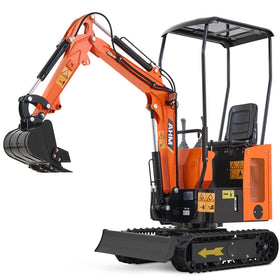
The average homeowner tackles 2-4 excavation projects yearly, most of which a compact 1-2 ton mini excavator can handle just fine. Bigger excavators deliver more power but generally cannot access residential spaces (at least not without posing some level of risk), while undersized mini excavators lack the force you might need.
That being said, the best strategy for choosing a mini excavator for home use is always to start with a good understanding of the kind(s) of projects you will be engaged in, and how demanding they might be. In other words, you need to know what you'll actually dig, how often, and where the machine needs to fit.

Mini Excavator For Home Use: What to Look For
When it comes to choosing a mini excavator for home use, your target should be to get a unit that has enough power to complete your projects, but is not too large to fit in tight areas. As such, you have to focus on factors like size, weight, digging depth, reach, and bucket capacity. Here's what to look for:
1. Start with Size and Weight
- For home use, it is generally advisable to go for a 2,500 lbs (1-1.5 tons)mini excavator that can fit through 36-42 inch gates with low ground pressure (3-5 PSI) for minimal lawn damage.
- A heavier 2-3 ton mini excavator (4,000-6,000 lbs) does indeed provide more power, but it will also need wider access and risks turf damage.
A good strategy for determining what size mini excavator you need for home use is to measure your narrowest access point and subtract 2-3 inches for safe clearance.
2. Consider the Digging Depth
Most residential projects need 60-80 inches maximum: utility trenches rarely exceed 48 inches, ponds top out around 60-72 inches, footings run 36-60 inches, and 69-73 inch dig depth covers typical home applications.
So, check the mini excavator's digging capacity: most mini excavators should do.
3. Reach and Bucket Capacity
For home projects, you need a mini excavator with a 120-inch maximum digging radius (10 feet horizontal). This is enough reach for working from edges without constant repositioning.
A standard 15.7-inch bucket (0.88 cubic feet) will also suffice to balance efficiency with precision. For larger or more "advanced" home projects, consider exploring more resources on how to choose the best mini excavator bucket.
 4. Attachments and Versatility
Verify that the hydraulic flow supports augers (10-15 GPM), hydraulic thumbs (8-12 GPM), and breakers (12-18 GPM), which are all mini excavator attachments you might need, depending on the nature of your project.
Don't forget to ensure that it is also compatible with quick-attach couplers. This attachment will help you swap tools in under 60 seconds and save you tons of time and energy.
5. Ease of Use
If you are looking to operate the mini excavator by yourself, or learn how to do it, you want a unit with relatively easier and universal control.
Mini excavators with hydraulic joystick controls with ISO standard configuration are known to be the easiest to learn. It is not rare for first-time operators to get comfortable within 30-60 minutes; pilot hydraulic systems respond instantly
6. Yard and Surface Protection
Mini excavators with rubber tracks are much safer to use on your property. Obviously, this depends on the nature of your project, but if you can, always go for rubber tracks. They reduce ground pressure to 3-5 PSI, preventing ruts.
Units with zero or reduced tail swing allow you to work 6 inches from fences and walls without property damage

Buying vs Renting a Mini Excavator for Home
The math on buying versus renting a mini excavator only really begins to make sense if you are estimating many projects you are likely to complete over a long period, like 3-5 years.
- Mini excavator rental costs tend to vary depending on the machine size, but recent reports estimate prices to stand at about $200-400 daily, $700-1,550 weekly, $1,800-3,675 monthly (depending on machine size).
- New mini excavators run $20,000-100,000, depending on size and features. Quality 1-2 ton machines from manufacturers like AHM start at $5,500-8,200. Used models range from $10,000 to $50,000 based on hours and condition.
Consider Buying a Mini Excavator for Home Use If:
- You have 3+ projects planned over the next 2 years
- Your property is 1+ acres, requiring ongoing maintenance
- You're doing a multi-phase landscape renovation
- Rental shops are 30+ minutes away (delivery fees add $100-200)
- You want specific attachmentsthat rental shops don't carry
Renting a Mini Excavator For Home Use Makes More Sense When:
- This is a one-time project
- You're testing whether you need excavation capability
- Storage space is limited
- You don't want maintenance responsibility
- The specific job needs a larger or specialized machine
 Affordable AHM Mini Excavators for Home Use
1. The AHM AX-12B Mini Excavator- $5,599.99
The AX-12B offers the lowest-cost entry into mini excavator ownership for residential projects. At 37 inches wide and 2,138 pounds, it fits through standard gates while delivering 2,585 lbf digging force. The 69-inch digging depth handles utility trenches, pond excavation, and foundation work for most home applications.
2. The AHM AX-12 Mini Excavator- $5,799.99
The AX-12 adds 7.8 inches of digging depth over the AX-12B through an upgraded boom design, reaching 73 inches total. Internal hydraulic routing protects hoses from damage when working in brush or tight spaces. The enhanced control panel includes a voltage meter and a timer for monitoring power and runtime.
Common Home Uses for a Mini Excavator
1. Landscaping
A small mini excavator for home use excavates 500 square feet of garden bed area in 2-3 hours, which makes it great for landscaping. You can complete landscaping tasks such as digging garden beds 2-3 feet deep, moving soil for terracing, creating slopes for drainage, and leveling uneven ground for lawns or patios.
2. Pond and Water Feature Installation
Excavating backyard ponds 10-15 feet across and 3-4 feet deep, digging trenches for decorative streams, and creating retention basins for water management. The precision control lets you shape varying depths for aquatic plants and fish habitats.
3. Foundation Work
Excavating deck footings (3-5 feet deep), shed foundations, small addition footings, and preparing ground for concrete slabs.

4. Stump Removal
Mini excavators remove stumps 8-16 inches in diameter by exposing and cutting root systems. Combine the bucket with a hydraulic thumb attachment for gripping and pulling stumps after severing anchor roots.
5. Demolition Projects
Breaking up old concrete patios, driveways, and walkways using hydraulic breaker attachments. Removing deteriorated retaining walls, tearing down small sheds or structures.
Driveway and pathway preparation: Clearing and grading for new driveways, excavating for proper base depth (8-12 inches), and removing old asphalt or gravel.
Safety Tips for First-Time Home Users
1. Get Basic Training
Watch manufacturer tutorial videos and practice in an open area before starting projects. Spend 30-60 minutes learning control sensitivity - joystick movements, track operation, boom swing limits. Most rental companies offer a brief operator orientation.
2. Always Call 811 Before Digging
Underground utility location services mark buried gas lines, electrical conduit, water mains, and sewer lines. Hitting a gas line or electrical cable creates safety hazards and repair costs exceeding $5,000.
3. Wear Proper PPE
Hard hat protects from overhead hazards, safety glasses with side shields block flying debris, steel-toed boots prevent foot injuries, work gloves improve grip on controls, and prevent blisters.
4. Practice Smooth Operation
Use controlled, gradual movements on all controls. Jerky inputs destabilize the machine and reduce precision. Start at half throttle while learning, increase speed as comfort improves.
 Final Thoughts on Choosing the Right Mini Excavator for Your Property
The best mini excavator for home use balances three factors - it fits through your tightest access point, delivers enough power for your hardest regular task, and costs less over 3-5 years than repeated rentals.
For most homeowners, the 1-2 ton mini excavators class (2,000-4,000 lbs) hits the sweet spot. A good mid-point might be a 1.3-ton mini excavator.
We recommend renting first if you're uncertain about usage frequency - the experience helps you understand which features matter before committing to purchase.