So, you’re thinking about removing some stumps in your front yard, but the contractor gave you two quotes: $360 for grinding, or $750 for complete removal. You nodded along during the explanation, but honestly, you're not entirely sure what the difference is beyond the $390 price gap. Both get rid of the stumps, right? Not quite.
Understanding stump grinding vs removal determines whether you're left with a clean slate for replanting or a yard full of decomposing roots that'll cause problems for years.
![]()
 What is Stump Grinding?
Stump grinding uses a specialized machine with a rotating cutting disc, called a stump grinder, to chip away the stump into fine wood particles. The grinder's carbide-tipped teeth shred the wood at 1,100-1,300 RPM, reducing the visible stump to ground level or below. The process typically reaches 4-12 inches below the surface, leaving the root system intact underground.
How Does Stump Grinding Work?
You position the grinder over the stump and lower the cutting wheel, grinding from the outer edges toward the center. Standard grinding reaches 6-8 inches below grade, though deeper grinding to 12-18 inches is available at additional cost.
When stump grinding is done, the entire root system stays underground and gradually decomposes over 3-10 years, depending on tree species and soil conditions. During decomposition, the area may settle as roots break down, sometimes creating small depressions.
Wood chips and sawdust fill the grinding area, and that is what is typically left after stump grinding. Most services backfill the hole with these grindings. The chips work as mulch but create a mounded appearance.
Pros and Cons of Stump Grinding
| Pros | Cons |
| Less expensive ($120-$400 per stump) | Roots remain underground and may sprout |
| Faster process (15 minutes to 2 hours) | Cannot replant trees in the same spot immediately |
| Minimal landscape disruption | Grinding depth limited to 4-12 inches standard |
| Wood chips can be repurposed as mulch | Potential for soil settling as roots decay |
| Safer for surrounding plants | Some species (elm, willow) may regrow from roots |
| No large hole to fill | Wood chips create a temporary mound |
| Less equipment and labor required | Not suitable if building foundations are planned |
What is Stump Removal?
Stump removal extracts the entire stump along with its root ball through excavation using heavy machinery like mini excavators or backhoes. An excavator digs a 3-foot diameter trench around the stump, reaching 2-3 feet deep to expose the primary root system.
 How Stump Removal Works
When removing stumps, you identify and cut the 4-6 major anchor roots (often 6-12 inches thick) using the bucket edge, ripper tooth, or chainsaw. Once severed, the bucket slides under the stump and applies leverage, rocking from multiple angles until it breaks free.
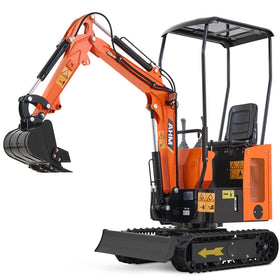
Grinding a tree stump vs removal requires different machinery. Removal uses mini excavators (1-6 tons for residential), backhoes, or specialized stump pullers. Hydraulic thumbs grip stumps during extraction, while ripper teeth cut through thick roots.
What Happens to Roots after Stump Removal?
Complete removal extracts the stump and primary root ball (typically 3-5 feet in diameter). Smaller feeder roots beyond this radius remain underground but die quickly without the main stump.
A significant hole remains - often 4-6 feet across and 2-3 feet deep for medium stumps. This requires backfilling with soil and compacting in layers. The area needs 6-12 months to fully stabilize before supporting structures.
Pros and Cons of Stump Grinding
| Pros | Cons |
| Complete eradication of the stump and roots | More expensive ($250-$675 per stump) |
| No risk of regrowth or sprouting | Time-consuming (30 minutes to 2+ hours per stump) |
| Area immediately usable for replanting | Creates a large hole requiring backfilling |
| Prevents pest infestations in decaying wood | More landscape disruption |
| Clean slate for construction projects | Requires heavy equipment and skilled operators |
| Roots won't interfere with new plantings | May damage the surrounding grass and plants |
| No soil settling issues later | Stump disposal adds cost ($25-50 extra) |
Stump Removal vs Stump Grinding: Key Differences
| Factor | Stump Grinding | Stump Removal |
| Depth | 4-12 inches below ground (up to 18" with specialized equipment) | Complete root ball 2-3 feet deep |
| Roots | Remain underground to decompose over 3-10 years | Extracted with the stump and primary root ball |
| Cost | $120-$400 per stump ($2-6 per inch) | $250-$675 per stump |
| Time | 15 minutes to 2 hours | 30 minutes to 4+ hours |
| Equipment | Stump grinder (wheel-based or handheld) | Mini excavator, backhoe, or large excavator |
| Landscape Impact | Minimal disruption, surrounding grass undamaged | Significant soil disturbance, 3-4 foot disruption zone |
| Regrowth Risk | Possible with elm, willow, poplar, and honey locust | None - complete root extraction |
| Replanting Trees | Wait 1-3 years for root decomposition | Immediate replanting is possible after backfilling |
| What's Left | Wood chips (can be used as mulch) | Large hole requiring soil backfill |
| Best For | Lawns, gardens, budget-conscious projects | Construction sites, replanting areas, permanent solutions |
Stump Grinding vs Stump Removal: How to Choose
Choose stump grinding if:
- You're covering the area with grass, mulch, or garden beds
- Budget is limited, and you want a cost-effective removal
- You need quick removal with minimal landscape damage
- The area won't be used for construction or driveways
- You don't plan to plant another tree in that exact spot within 2-3 years
- You want to repurpose wood chips as mulch
- Multiple stumps need removal, and the cost per stump matters
Choose stump removal if:
- You're planning construction, patio installation, or driveway work over the location
- You want to plant a new tree in the same spot within the next year
- The tree species are known for aggressive regrowth (elm, willow, poplar, honey locust)
- You need a completely root-free area for underground utilities or irrigation
- Soil settling from decomposing roots would create problems
- You're doing a complete landscape renovation and want a clean slate
- You have access to heavy equipment, or the additional cost is acceptable

AHM Mini Excavators for Stump Removal
For property owners choosing complete stump removal, mini excavators provide a massive mechanical advantage.
AHM AX-16 - $7,499.99
The AX-16 delivers 26% more force at 2,923 lbf, handling medium stumps 12-16 inches in diameter. The 23 HP Briggs and Stratton Vanguard dual-cylinder provides 70% more horsepower, powering through hardwood stumps.
- Max digging depth: 71 inches
- Digging force: 2,923 lbf (26% increase)
- Engine: 23 HP Briggs & Stratton Vanguard
- Width: 39 inches
- 1000mm adjustable dozer blade
AHM AX-17 - $12,499.99
The AX-17 delivers maximum capability with 88.9-inch digging depth and swing boom versatility. At 3,651 pounds with a 551 lb lifting capacity, it handles large stumps 18-24 inches in diameter.
- Max digging depth: 88.9 inches (deepest reach)
- Max load capacity: 551 lb (handles heavy root balls)
- Swing boom: 45° left, 55° right pivot
- Pilot hydraulic controls
- Zero tail swing
 The Bottom Line
Stump grinding vs removal comes down to future land use and budget. Grinding costs $120-$400 per stump, takes 15 minutes to 2 hours, and reaches 4-12 inches below ground - perfect for lawns and gardens. The process leaves roots underground to decompose over 3-10 years, with possible regrowth in some species.
Removal costs $250-$675 per stump, requires 30 minutes to 4+ hours, and extracts the complete stump and root ball 2-3 feet deep. This method suits construction projects, replanting locations, and situations requiring root-free areas.
All things considered, choose grinding for quick, budget-friendly removal. Choose removal when you need complete root clearance for replanting or building. No matter which path you choose, AHM mini excavators have got your back.
Explore AHM mini excavators to find your perfect model, and take a look at a more in-depth guide on how mini excavators for stump removal work.