So, your yard looks bare. The lawn's fine, but everything else feels like an afterthought - some scattered shrubs and a few struggling plants you can't remember planting. You walk past perfectly landscaped homes with flower beds bursting with color from spring through fall, and you wonder how they do it.
Picking what flowers are good for landscaping comes down to understanding bloom times, maintenance requirements, and matching plants to your specific conditions. And today, we’re going to answer all your questions.

Why do Flowers Add Value to Landscaping
Planting flowers is one of the top 5 landscaping projects for your property. Flowers can transform outdoor spaces from functional to inviting. Homes with well-maintained flower beds can increase property value by 10-30%, matching returns from hardscaping projects.
Beyond finances, landscaping with flowers provides environmental benefits as well:
- Absorb carbon dioxide and produce oxygen
- Prevent soil erosion
- Cool urban areas by several degrees compared to bare ground
- Support pollinators like bees and butterflies
How to Choose the Right Flowers for Landscaping
1. Perennials vs Annuals
Perennials bloom year after year from the same root system, typically living 3-10+ years or even decades for varieties like peonies and hostas. They cost $8-20 per plant upfront, but you plant once and enjoy the blooms repeatedly.
The gardening adage "first year sleeps, second year creeps, third year leaps" holds true - perennials take 2-3 seasons to reach full maturity.
Annuals complete their life cycle in one season, then die. They provide longer bloom periods - often flowering continuously from planting until frost - but require replanting annually at $2-5 per plant.
Professional landscapers combine both: perennials form the backbone while annuals fill gaps and provide continuous color.
2. Consider Different Flowers for Different Seasons
Planning for succession blooms makes sure that your landscape looks vibrant year-round:
Spring bloomers (March-May):
- Daffodils, tulips, hyacinths, crocuses
- Plant bulbs 6-8 inches deep for larger varieties
- Plant 3-4 inches deep for smaller crocuses
- Space bulbs 4-6 inches apart
Summer bloomers (June-September):
- Daylilies, black-eyed Susans, coneflowers, bee balm
- Handle heat well and attract pollinators
- Hostas provide substantial foliage in shade, with bonus flower stalks
Fall bloomers (August-October):
- Asters bloom in purple and pink shades
- Chrysanthemums provide classic fall color
- Plant mums by mid-summer to establish roots before winter

3. Low Maintenance vs High Maintenance Plants
Low-maintenance perennials require minimal work and include balloon flowers, daylilies, hostas, and black-eyed Susans. These plants offer:
- Minimal deadheading requirements
- Pest and disease resistance
- Drought tolerance once established
- No staking needed
- Self-cleaning blooms (labeled on plant tags)
High-maintenance options like dahlias, roses, and delphiniums demand regular attention - staking, frequent deadheading, and specific fertilization schedules. Expect to spend 2-3 hours weekly maintaining these during peak season, but the payoff is dramatic.
For landscaping with hostas and flowers in shade, pair hostas with astilbe, bleeding hearts, and coral bells.
4. Try Color Schemes and Layout Tips
Follow color theory to transform your random plantings into cohesive designs:
Complementary colors (opposites on the color wheel):
- Purple and yellow (catmint with 'Moonshine' yarrow)
- Blue and orange
- Red and green
- Creates high-contrast, vibrant displays
Analogous schemes (adjacent colors):
- Blue, purple, and violet together
- Creates harmonious, calming landscapes
Monochromatic designs:
- Various shades of one color
- White flowers work as neutral additions to any scheme
Plant height should determine its placement. Position tall plants (3-4 feet) toward the back, mid-height plants (1-2 feet) in the middle, and short plants (under 12 inches) up front. For island beds, place tall plants in the center and work outward.

Preparing Your Garden for Planting: The Role of Mini Excavators
A mini excavator will come in handy for preparing large-scale flower beds. Creating new beds requires excavating 8-12 inches deep to remove grass and break up compacted soil, and hand-digging a 300-square-foot bed takes two people 6-8 hours.
Mini excavators transform this process. A 1-2 ton compact excavator with 69-88 inch digging depth can handle residential excavations in 90 minutes to 2 hours.
Advantages of Mini Excavator for Flower Planting
- Create uniform depths critical for proper drainage
- Grade the soil to create 2% slope, preventing water pooling
- Break through clay layers and rocky subsoil
- Prepare ground for deep-rooted perennials needing 12-18 inches of soil
- Move 3-4 cubic yards of compost, topsoil, or mulch per hour
- Fit through standard 36-37 inch gates for backyard access
Best Mini Excavators for Landscaping Projects
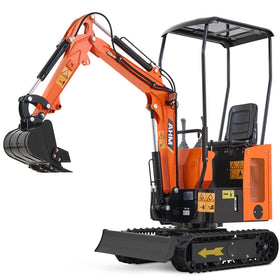
1. The AHM AX-12C - $6,399.99
The AX-12C delivers residential landscaping capability in an enclosed cab design, protecting operators from weather and dust during extended projects. This 1-ton excavator fits through standard gates while providing the depth and force needed for soil preparation. The 13.5 HP Briggs & Stratton engine provides reliable power with exceptional fuel efficiency at 0.26 gal/h - roughly $2-3 in fuel for a full day.
2. The AHM AX-16C - $9,299.99
The AX-16C features a swing boom that pivots independently from the cab, making it exceptional for working alongside existing flower beds and foundations without repositioning.
The 23 HP Briggs & Stratton Vanguard dual-cylinder engine delivers 70% more horsepower than standard 13.5 HP models, powering through compacted clay and rocky soil. The 71-inch digging depth handles deeper pond excavations and provides extra reach for terracing sloped yards.
Flowers for Landscaping: Planting Tips and Maintenance
1. Pay Attention to Planting depth and spacing
- Plant bulbs 2-3 times deeper than the bulb's height
- Tulip and daffodil bulbs: 6-8 inches deep
- Container-grown perennials: sit level with the surrounding soil
- Large perennials: 18-24 inches between plants
- Hostas expand to 2-4 foot wide clumps within 3 years
2. Watering requirements:
- New plantings: water every 2-3 days for the first month
- Then water 1 inch weekly
- Ensure moisture reaches 6-8 inches deep
3. Proper Use of Mulching
- Apply 2-3 inches of organic mulch around plants
- Keep mulch 2 inches from stems to prevent rot
4. Practice Maintenance
- Deadheading: Remove old flowers to extend bloom periods
- Cut flower stalks back to foliage on daylilies, coneflowers, and bee balm

The Bottom Line
What flowers are good for landscaping depends on sun exposure, soil type, hardiness zone, and maintenance time available. Perennials like daylilies, coneflowers, and hostas provide 5-10+ years of returns, while annuals deliver continuous color through the growing season.
- Plan for succession blooms by combining spring bulbs, summer perennials, and fall bloomers.
- Mini excavators reduce manual labor by 50-70%, creating uniform planting depths in hours rather than days.
Start small with low-maintenance options like black-eyed Susans and hostas. Master basic care - proper watering, annual mulching, periodic division - then expand to more demanding varieties as you go.
You might also want to understand the differences between landscaping and hardscaping.