Any project that involves changing what’s under or around your home needs excavation.
If you’re fixing a foundation, you can’t do that without digging down to it. Installing a pool means, for example, requires excavating to a precise depth and shape. Upgrading sewer, water, or electrical lines requires trenching that avoids gas lines and other buried utilities, which are typically located 3–6 feet underground.
And here’s the important part: if the excavation isn’t done right, problems show up later. Poor excavation can lead to uneven settling, cracked walls, water collecting near your foundation, basement flooding, or even sinkholes forming in driveways and walkways months after the job is finished.
That’s why excavation often makes up 15–25% of the total project cost. It’s not flashy, but it sets the foundation, literally, for everything that comes next.
 What Is Residential Excavation?
At its core, residential excavation is just digging; it's about digging with a purpose.
It’s the process of removing soil, rock, or other material from a residential property so things like foundations, utility lines, drainage systems, or landscaping features can be installed properly.
Unlike big commercial excavation projects for highways or skyscrapers, residential excavation is all about accuracy. Contractors aren’t just moving dirt around. They’re digging only where needed, carefully working around homes, fences, landscaping, and underground utilities.
That’s also why homeowners are often surprised when excavation alone costs $1,500 to $7,000, and construction hasn’t even started yet.
Common Types of Residential Excavation
There isn’t just one kind of residential excavation. Different jobs call for different approaches, from topsoil excavation, earth excavation, trench excavation, foundation excavation, basement excavation, rock excavation, and drainage excavation.
| Type of Residential Excavation | What It’s Used For | Summary Explanation |
| Topsoil Excavation | Preparing land for foundations and hardscaping | Removes the top layer of soil with roots and grass; often reused for landscaping. |
| Earth Excavation | Foundations, basements, and utilities | Digs below topsoil to make space for structures or utilities; soil may be reused elsewhere. |
| Trench Excavation | Utility lines (water, sewer, gas, electric) | Creates narrow trenches for pipes and conduits. |
| Foundation Excavation | Home additions, garages, sheds | Prepares the ground for buildings, slightly wider than the structure for the workspace. |
| Basement Excavation | Full or partial basements | Removes large amounts of soil below ground for basements with proper depth and drainage. |
| Rock Excavation | Bedrock and large boulders | Breaks and removes hard rock when standard digging isn’t enough. |
| Drainage Excavation | Water management around homes | Creates channels or trenches to redirect water away from the house. |
Advantages of Residential Excavation
Residential excavation isn’t always the easiest or cheapest option, but it has some clear advantages: it is effective for making permanent repairs, allows for more accurate visual control of the project, and also leaves ample opportunities for upgrades.
1. Great For Making Permanent Repairs
Residential excavation allows for permanent repairs, not temporary fixes. With residential excavators, a contractor can fully replace sewer lines, water mains, or electrical systems instead of patching damaged sections.
2. Allows Visual Confirmation
It also allows for visual confirmation. During residential excavation, contractors can see exactly what they’re working on, check pipe slope, confirm depth, and make sure everything is compacted properly before closing things back up.
3. It is an Effective Solution for Several Problems
Another advantage of residential excavation is that it is sometimes the only solution. Excavation is often the only solution for severe problems, like collapsed pipes, crushed utility lines, or compromised foundations.
4. It Leaves Space for Upgrades and Improvement
Residential excavation also creates opportunities for upgrades. If the ground is already open, contractors can increase pipe size, add cleanouts, improve drainage, or relocate utilities for better long-term performance.
And for new construction or major renovations, excavation makes it possible to install multiple utilities at once, reducing future disruption.
 Residential Excavation vs. Sewer Pipe Lining
When sewer problems arise, homeowners choose between excavation (traditional repair) and pipe lining (trenchless repair). Understanding the differences will help determine which method suits specific situations.
| Factor | Residential Excavation | Sewer Pipe Lining (Trenchless) |
| Invasiveness | Requires digging trenches along the entire damaged section | Minimal digging - only small access points at pipe ends |
| Time Required | Several days to a week | Hours to 2 days |
| Cost | $50-$250 per foot plus restoration | $80-$250 per foot (30-40% less total with restoration savings) |
| Property Disruption | Significant - damages landscaping, driveways, sidewalks | Minimal - preserves existing landscaping |
| Pipe Lifespan | 50+ years with new pipes | 50+ years with epoxy lining |
| Best For | Completely collapsed pipes, severe damage, and pipe relocation | Cracks, root intrusion, minor to moderate damage |
| Limitations | Highly disruptive, expensive restoration costs | Can't repair collapsed pipes; requires existing pipe integrity |
| Repair Quality | Direct access allows visual verification | Camera inspection verifies, but no physical access |
| Future Access | Can upgrade pipe size, add access points | Cannot modify pipe diameter or configuration |
Affordable Mini Excavators for Residential Excavation
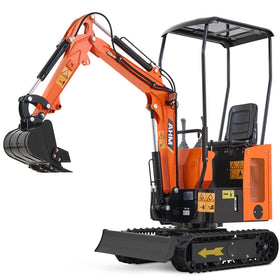
1. AHM AX-12B - $5,599.99
The AX-12B handles residential excavation with a 69-inch digging depth covering most foundation, utility, and drainage requirements. At 2,138 pounds and 37 inches wide, it fits through standard residential gates, accessing backyards where larger equipment requires removing fences.
Key Features for Residential Work:
- Max digging depth: 69 inches (5.75 feet)
- Digging force: 2,585 lbf
- Width: 37 inches (fits standard gates)
- Fuel consumption: 0.26 gal/h
- Reduced tail swing (minimal property damage risk)
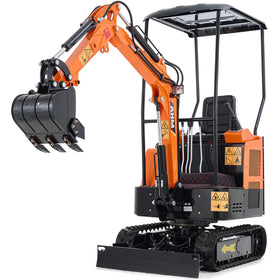
AHM AX-12 - $5,799.99
The AX-12 provides 73-inch digging depth - 7.8 inches more than the AX-12B - handling deeper utility trenches and foundation footings without repositioning. Internal hydraulic routing protects hoses from damage while working in tight residential spaces around existing structures.
- Max digging depth: 73 inches (6.1 feet)
- Digging force: 2,585 lbf
- Width: 37 inches
- Internal hydraulic hoses (improved safety)
- Enhanced control panel with a voltage meter
The Bottom Line
Residential excavation provides direct access for permanent repairs, visual verification during installation, and flexibility for system upgrades. The method suits new construction, complete utility replacements, and severe damage situations. Choose excavation equipment matching your project's deepest requirement plus a buffer, verify gate access dimensions, and prioritize reduced or zero tail swing for working in residential landscapes without property damage.